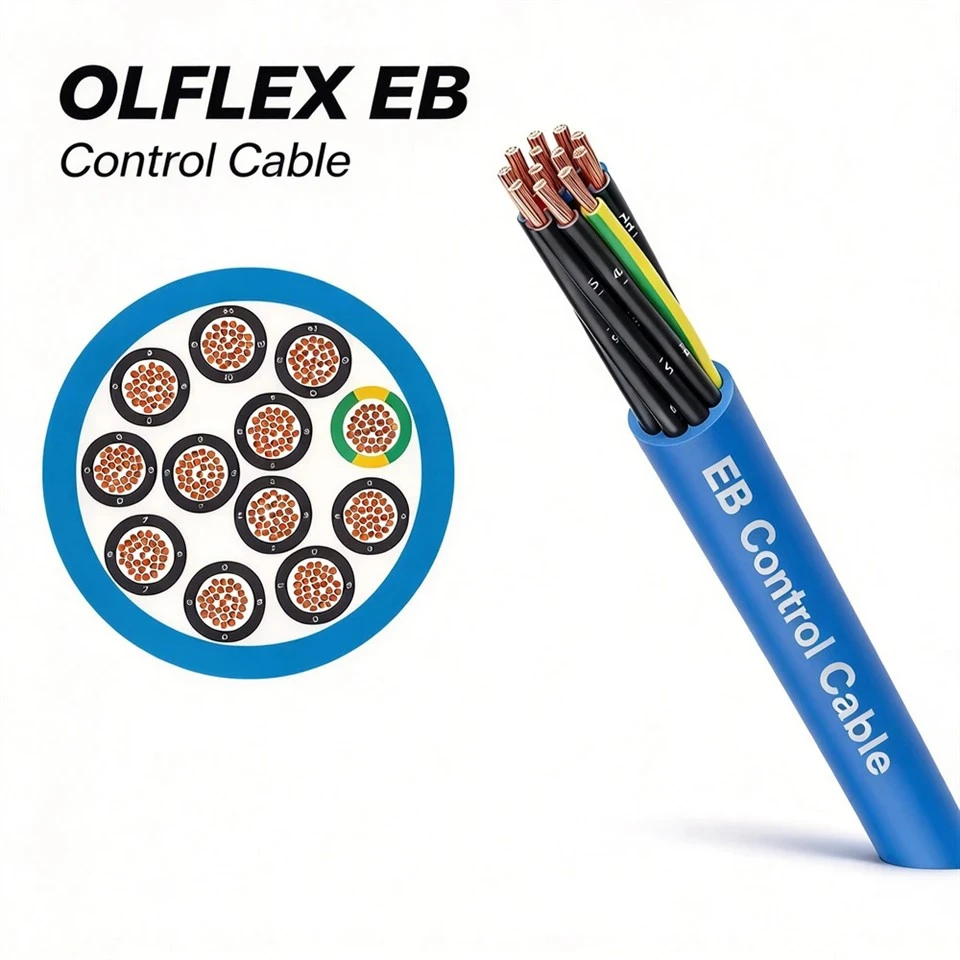

Xiamen Kabasi Electric Co., Ltd. is one of the most reliable manufacturers and suppliers of olflex eb control cable in China. If you're going to buy bulk durable cables made in China, welcome to get pricelist from our factory. All customized cables are with high quality and competitive price.
Lead Paragraph
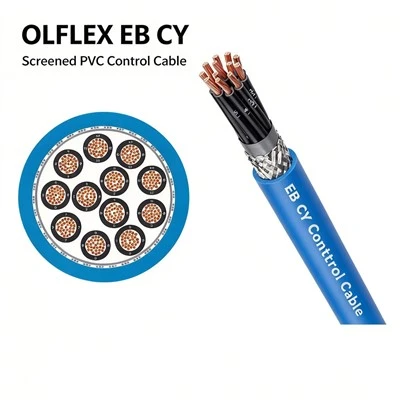
OLFLEX EB is the unshielded 300/500 V PVC control cable built for Type i intrinsically safe (IS) measurement and signalling loops in hazardous plants (Zone 1, Zone 2, Zone 21, Zone 22). To IEC 60079-14:2013 and EN 60079-14:2014 clause 16.2.2, IS circuits must stay visibly separated from non-IS power wiring, so the sky-blue sheath (RAL 5015) is identified at a glance during audits. A low mutual capacitance of 140 nF/km and inductance of about 0.52 mH/km leave maximum loop-length headroom inside Zener-barrier and isolator capacitance budgets (Co). Without a braided screen the cable is slimmer and terminates faster in multi-channel marshalling cabinets.
Select Your Variant: Unscreened EB vs Screened EB CY
Both builds are 300/500 V, both are Type i IS cable, both carry the sky-blue sheath. The difference is whether a tinned-copper braid sits under the jacket, and that single layer decides what the cable can be used for.
| What you are choosing | EB - unscreened | EB CY - screened | |
| Screening | None - there is no braid to terminate | Tinned-copper braid, carried with the cable | |
| Route | Dedicated instrument trays, free of heavy interference | Shared trays with drive leads, inverter busbars or other high-energy cabling | |
| Effect on the loop | One capacitance term | Two capacitance terms, so the same barrier buys less run | |
| Installation cost |
|
Larger diameter, wider bend radius | |
| Protective core | G build at 1.5 mm² | No G build |
Typical Applications
This unshielded intrinsically‑safe control cable works well for
marshalling‑cabinet‑to‑field‑transmitter runs where heavy‑noise power‑cable crosstalk is absent. If instrument routes run in shared cable trays alongside large variable‑speed‑drive power cables, evaluate the screened EB‑CY variant instead. Remember that blue sheath colour is site‑identification practice only; it does not by‑itself grant compliance for hazardous‑zone installation. Full compliance depends on correct circuit design, barrier selection and installation workmanship.

Why Choose OLFLEX EB Series
|
Advantage |
What It Means On Site |
| 140 nF/km core-to-core, and no core-to-screen term. | Mutual capacitance is what limits how far a loop can run before the barrier's C_o budget is used up. EB quotes 140 nF/km with nothing added for a screen, because there is no screen - the whole figure is available to the loop length. |
| Sky-blue to approximately RAL 5015. | Colour is the identification method the standard relies on, and it does not rub off, fade under tray lighting or get removed during a re-termination. An auditor reads the circuit from the tray, not from a label. |
| No screen, so the smallest construction in the pair. | Without a braid, and without the foil wrap that sits under it on the screened build, the same core count builds to a smaller diameter and a lower weight. That is the margin between fitting another bundle into an existing duct and opening a new one. |
| Rated for outdoor and chemical duty. | UV and weathering stability to ISO 4892-2, flame retardancy to IEC 60332-1-2 and good chemical resistance, on one PVC jacket rather than three different cable types. |
Frequently Asked Questions
Q: Does a sky-blue outer jacket automatically certify an electrical installation as intrinsically safe?
A: No. The blue sheath (approximating RAL 5015) is an identification measure required by IEC 60079-14 clause 16.2.2 to visibly separate intrinsically safe wiring from non-IS circuits. The physical compliance of the circuit depends strictly on the system's electrical loop design: proving that total cable capacitance (C_c) and inductance (L_c) plus field device values do not exceed the certified barrier parameters (C_o and L_o), alongside proper separation and earthing practices.
Q: When is unshielded OLFLEX EB preferred over screened OLFLEX EB CY?
A: OLFLEX EB is preferred when intrinsic safety loops are installed in dedicated instrument trays, separate cable conduits, or low-noise process plant areas where strong electromagnetic interference is absent. Because EB has no copper shield braid, it is thinner, lighter, faster to terminate, and exhibits lower mutual capacitance (140 nF/km vs 160 nF/km core-core plus 250 nF/km core-screen on EB CY), maximizing allowable loop distance under restrictive barrier capacitance limits.
Q: Can intrinsically safe cables be routed in the same conduit with standard power cables?
A: No. Under IEC 60079-14 regulations, intrinsically safe circuits must be physically segregated from all non-intrinsically safe circuits. They must be routed in separate conduits or segregated by a continuous metal or insulating partition within shared cable trays (minimum 50 mm clearance), ensuring that high-voltage power faults cannot inductively couple energy into the energy-limited IS loop.
Q: What is the practical difference between the G and X versions in the part number table?
A: G denotes that the cable includes one green-yellow protective grounding conductor, whereas X indicates all cores are black with white printed numbers without an earth wire. On 1.5 mm² sizes where both builds are available, the green-yellow core replaces one numbered conductor; diameter, weight and electrical ratings remain identical.
Q: Is the sky-blue PVC sheath suitable for outdoor petrochemical pipe-racks?
A: Yes. The specialized PVC outer compound is formulated and tested for UV and weather resistance in accordance with ISO 4892-2. It withstands continuous outdoor sunlight and industrial airborne pollutants within a fixed operating temperature range of −40 °C to +80 °C, eliminating the need for UV-protective conduit over open tray runs.
Q: Does KABASI offer pre-wired intrinsically safe cable harnesses?
A: Yes. As a certified wire harness manufacturer and cable specialist, KABASI supplies bulk master reels, pre-cut installation kits, and custom-assembled hazardous-area wiring harnesses. We terminate OLFLEX EB with explosion-proof junction gland assemblies, certified Ex-d/Ex-e field plugs, or pre-marked ferrule harnesses tailored to your marshalling enclosure schedule.
Hot Tags: olflex eb control cable, China olflex eb control cable suppliers
Baseline Ratings - EB
| Parameter | Value |
| Rated voltage U₀/U | 300/500 V |
| Inductance | approx. 0.52 mH/km |
| Conductor | Class 5 fine-wire bare copper, VDE 0295 / IEC 60228 |
| Insulation | PVC, LAPP P8/1 |
| Sheath | PVC, sky-blue, approximately RAL 5015 |
Variant Comparison
| Property | EB | EB CY |
|
Nominal Operating Voltage (U₀/U) |
None | Tinned-copper braid |
|
Conductor Construction |
- | ≤ 250 Ω/km at 30 MHz |
|
Core Dielectric Insulation |
None | Plastic foil |
|
Core Identification System |
140 nF/km | 160 nF/km |
|
Core Assembly & Stranding |
- | 250 nF/km |
|
Outer Protective Sheath |
G at 1.5 mm² | None |
Sizing Reference & Cross-Section Lookup
All conductors are manufactured to European metric standards (VDE 0295 Class 5). The integrated AWG reference in the ordering tables indicates the closest equivalent North American conductor cross-section for project engineering documentation and ferrule sizing.
OLFLEX EB 300/500 V — Part Number Selection
Full range of certified catalogued items; G denotes inclusion of one green-yellow protective earth core; X denotes all black numbered cores:
|
Part No. |
Cores × Conductor (mm²) |
Approx. AWG |
Outer Diam. (mm) |
Copper Index (kg/km) |
Cable Weight (kg/km) |
|
0012420 |
2 × 0.75 |
18 |
5.4 |
14.7 |
50 |
|
0012421 |
3 × 0.75 |
18 |
5.7 |
22.1 |
60 |
|
0012422 |
4 × 0.75 |
18 |
6.2 |
29.4 |
70 |
|
0012423 |
5 × 0.75 |
18 |
6.7 |
36.8 |
85 |
|
0012424 |
7 × 0.75 |
18 |
7.3 |
51.5 |
110 |
|
0012425 |
12 × 0.75 |
18 |
9.9 |
88.2 |
180 |
|
0012426 |
18 × 0.75 |
18 |
11.7 |
132.3 |
260 |
|
0012427 |
25 × 0.75 |
18 |
13.9 |
183.8 |
360 |
|
0012430 |
2 × 1.0 |
17 |
5.7 |
19.6 |
60 |
|
0012431 |
3 × 1.0 |
17 |
6.0 |
29.4 |
70 |
|
0012432 |
4 × 1.0 |
17 |
6.5 |
39.2 |
85 |
|
Part No. |
Cores × Conductor (mm²) |
Approx. AWG |
Outer Diam. (mm) |
Copper Index (kg/km) |
Cable Weight (kg/km) |
|
0012435 |
12 × 1.0 |
17 |
10.5 |
117.6 |
230 |
|
0012436 |
18 × 1.0 |
17 |
12.7 |
176.4 |
340 |
|
0012437 |
25 × 1.0 |
17 |
14.7 |
245.0 |
460 |
|
0012500 |
2 × 1.5 |
15 |
6.3 |
29.4 |
70 |
|
0012501 |
3 G 1.5 |
15 |
6.7 |
44.1 |
90 |
|
0012441 |
3 × 1.5 |
15 |
6.7 |
44.1 |
90 |
|
0012502 |
4 G 1.5 |
15 |
7.2 |
58.8 |
110 |
|
0012442 |
4 × 1.5 |
15 |
7.2 |
58.8 |
110 |
|
0012503 |
5 G 1.5 |
15 |
8.1 |
73.5 |
135 |
|
0012443 |
5 × 1.5 |
15 |
8.1 |
73.5 |
135 |
|
0012504 |
7 G 1.5 |
15 |
8.9 |
102.9 |
180 |