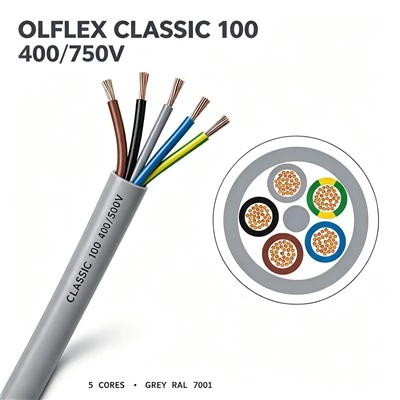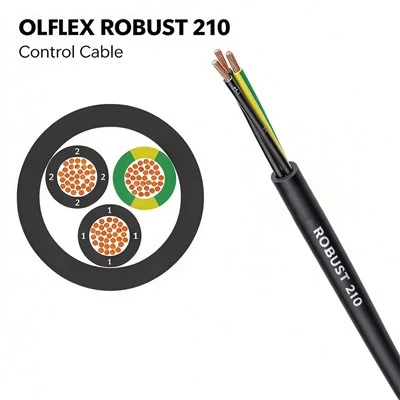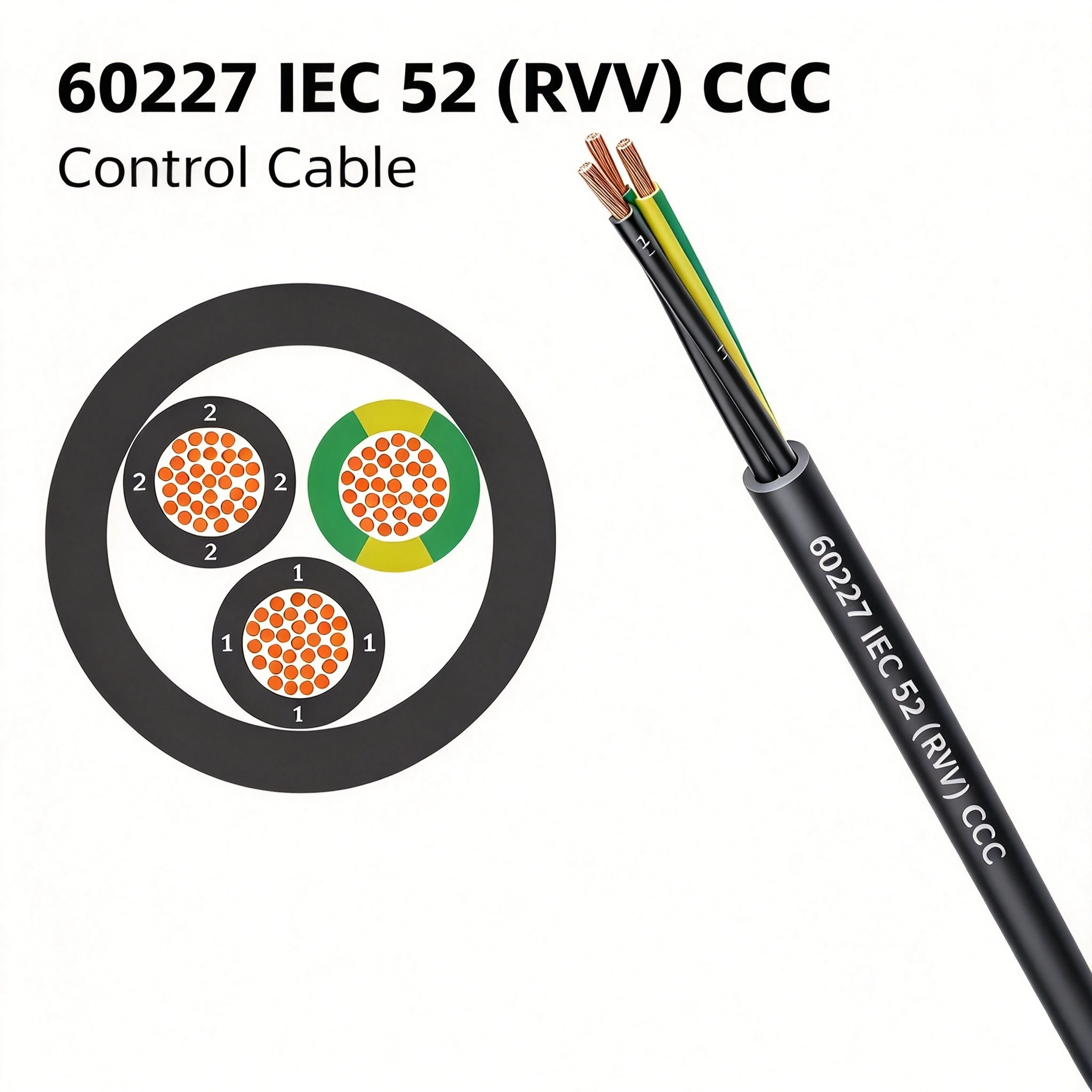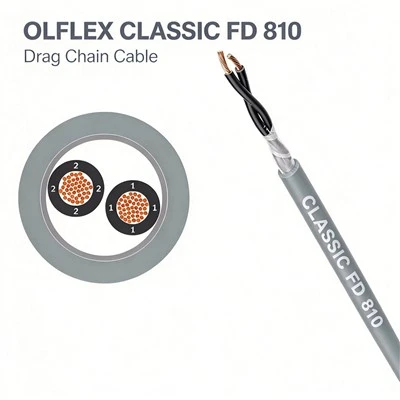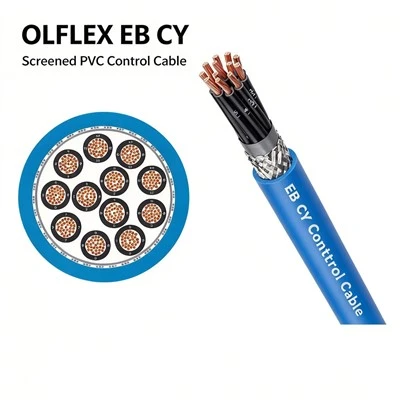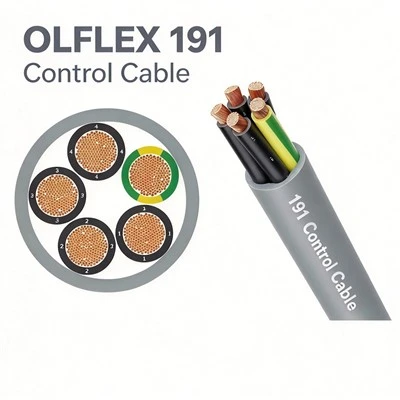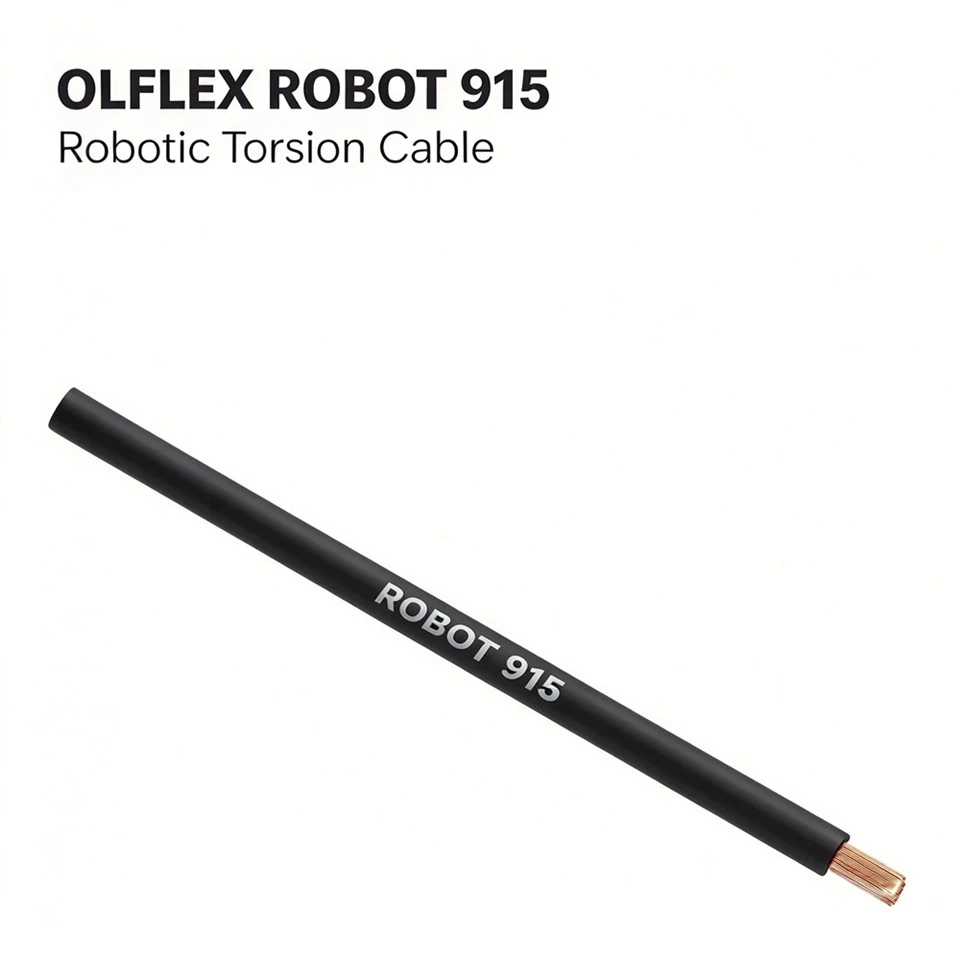
Xiamen Kabasi Electric Co., Ltd. is one of the most reliable manufacturers and suppliers of olflex robot 915 robotic torsion cable in China. If you're going to buy bulk durable cables made in China, welcome to get pricelist from our factory. All customized cables are with high quality and competitive price.
Lead Paragraph
OLFLEX ROBOT 915 is a single-core robotic torsion cable built to take the rotation an ordinary flexible core will not: a Class 6 extra-fine bare copper conductor under special PVC, rated for a maximum twist of ±180°/m and published for 5 million bending cycles at a 7.5 × OD radius, 1 m/s running speed and 2 m of horizontal chain travel. The 450/750 V grade covers 1.5–95 mm² in five insulation colours, is tested at 2500 V and carries TÜV approval to 2PfG 2577/07.19 as IRS07V-H, Class III. A 0.6/1 kV version with a 4000 V test voltage uses the same conductor, insulation, torsion rating and temperature range. Supplied on coils or drums, and cut to length, stripped and terminated as a finished dress-pack assembly.
Select Your Variant
By Voltage Grade
|
Parameter |
ROBOT 915, 450/750 V |
ROBOT 915, 0.6/1 kV |
|
Rated voltage (U₀/U) |
450/750 V |
600/1000 V |
|
Test voltage |
2500 V |
4000 V |
|
Conductor |
Class 6 extra-fine bare copper |
Identical |
|
Insulation |
Special PVC |
Identical |
|
Torsion rating |
±180°/m |
Identical |
|
Bend-life rating |
5,000,000 cycles at 7.5 × OD |
Identical |
|
Temperature - dynamic |
−30 °C to +90 °C |
Identical |
|
Cross-section range |
1.5 – 95 mm² |
1.5 – 95 mm² |
|
Insulation colours |
Black / white / red / grey / green-yellow |
Black / white / red / grey / green-yellow |
|
OD at 4 mm² |
4.6 mm |
5.0 mm |
|
Part number prefix |
83010028 |
83010038 |
|
Typical destination |
Axis-6 wrist rotation and dress packs on 400 V drives |
Routes where the system voltage or the installation standard calls for 0.6/1 kV |
By Insulation Colour
|
Colour |
Part number suffix |
Where it is used |
|
Black |
01 – 11 |
General power core; the default in most dress packs |
|
White |
21 – 31 |
Second power core where two supply conductors run in one bundle |
|
Red |
41 – 51 |
Phase or signal core identified against black in the same loom |
|
Grey |
61 – 71 |
Neutral or return core; also chosen where a core should read as visually neutral |
|
Green-yellow |
81 – 91 |
Protective earth; the one core that must never be confused with the others |
Typical Applications


Why Choose OLFLEX ROBOT 915 Series
|
Advantage |
What it means on site |
|
A Torsion Rating, Not Only a Flexibility Claim |
Most high-flex single cores are tested for repeated bending and nothing else. ROBOT 915 carries a stated twist limit of ±180°/m, which is the load an axis-6 wrist actually imposes. Where a core is chosen on flexibility alone, the failure on a rotating axis is broken strands inside the insulation - invisible until the core goes open circuit and the line stops. |
|
A Five Million Cycle Figure That Names Its Conditions |
The bend-life claim is published with the test conditions attached: 7.5 × OD radius, 1 m/s, 2 m horizontal travel. A cycle count without those conditions cannot be checked against a real axis. Because the assumptions are stated, they can be compared with your machine before the order is placed rather than after a failure. |
|
Class 6 Stranding Keeps the Dress Pack Thin |
Extra-fine Class 6 stranding is what lets the core take repeated twist without the strand-level work-hardening that ends a Class 5 conductor. The practical gain is a smaller outer diameter for the same cross-section - 3.5 mm at 1.5 mm² - which matters when several single cores have to share one dress pack through a restricted bend. |
| A Third-Party Robot-Cable Standard Behind the Rating | The 450/750 V range is TÜV Rheinland approved to TÜV 2PfG 2577/07.19 as IRS07V-H, Class III; the 0.6/1 kV range is built to the same 2PfG 2577/07.19 classification. Either way the rating comes from a published robot-cable standard rather than a supplier description. |
Torsion or Bending - Which Rating Applies on Your Axis
ROBOT 915 is rated for both torsion and flexing, so the first question on any new application is which of the two loads the route actually applies. Get that wrong and the cable is selected against the wrong half of the datasheet.
|
Axis or route section |
Dominant load |
Which rating governs the decision |
|
Axis 1–3 - base, shoulder, elbow |
Repeated bending over a small radius |
The bend-life claim: radius, running speed and travel. Torsion is not the limiting factor here. |
|
Axis 4–6 - wrist and tool rotation |
Torsion |
The ±180°/m twist limit. What matters in practice is the length of the loop, because a longer loop spreads the same angle over more cable. |
|
Cable carrier running along the axis |
Linear flexing at a fixed radius |
The bend-life claim, and the 6 × OD dynamic floor below it. |
|
Static loom inside the cabinet |
None |
Fixed-installation temperature range only; the torsion and bend ratings are not engaged. |
A core that crosses between two of these sections sees both loads, and the two demands pull in opposite directions: the loop length that serves a torsion section adds unsupported span to the carrier section. Where a single core has to do both, treat the tighter of the two constraints as the design limit and confirm the assembly drawing before the cores are cut.
Frequently Asked Questions
Q: What makes this a torsion-rated cable rather than simply a flexible one?
A: The rating itself. ROBOT 915 carries a stated twist limit of ±180°/m on top of its bend-life figure, and it is approved to TÜV 2PfG 2577/07.19 as IRS07V-H, Class III - a robot-cable standard that tests torsion. A cable described only as flexible has usually been tested for repeated bending, which is a different load. On a rotating axis, a bend-only cable fails as broken strands hidden inside the insulation.
Q: Is the five million cycle figure a bending claim or a torsion claim?
A: It is a bending claim, and it is conditional. Five million cycles applies at a 7.5 × OD bend radius, 1 m/s running speed and 2 m of horizontal chain travel. Torsion is covered separately by the ±180°/m limit. Note that the minimum dynamic bend factor is 6 × OD while the life figure is published at 7.5 × OD - routing at the mechanical minimum is allowed, but it is outside the published life curve.
Q: Why single core instead of a multicore control cable?
A: Because of how a dress pack is built. Each axis core is cut to its own length and terminated at its own point, so a multicore sheath adds bulk and a bend radius penalty without removing any work. Single cores also let one core be replaced without disturbing the rest of the loom. The trade-off is that identification moves to the insulation colour, which is why five colours are stocked.
Q: Which voltage grade should I order, 450/750 V or 0.6/1 kV?
A: 450/750 V covers the common case - axis-6 wrist rotation and dress packs on 400 V drive systems - and it is the grade this page leads with. Move to 0.6/1 kV when the system voltage or the installation standard requires it. The conductor, insulation, torsion rating, bend life, temperature range and the five available insulation colours are identical between the two, so the choice does not affect mechanical performance.
Q: Can it be supplied cut, stripped and terminated?
A: Yes. Cable can be supplied as a plain cut length, or built into a finished assembly cut to your dress-pack drawing with the core stripped, terminated and the green-yellow protective earth core identified ready for landing. Send the drawing and the loop lengths and we will confirm the build, the packing format and the delivery schedule.
Hot Tags: olflex robot 915 robotic torsion cable, China olflex robot 915 robotic torsion cable suppliers
Common Specifications - Both Voltage Grades
|
Parameter |
Value |
|
Conductor |
Class 6 extra-fine bare copper, bunched (VDE 0295 Class 6 / IEC 60228 Class 6) |
|
Insulation |
Special PVC |
|
Core identification |
Insulation colour - single core |
|
Rated voltage |
450/750 V (U₀/U); 600/1000 V on the 0.6/1 kV grade |
|
Test voltage |
2500 V; 4000 V on the 0.6/1 kV grade |
|
Torsion rating |
±180°/m maximum twist |
|
Bend-life rating |
5,000,000 cycles at 7.5 × OD, 1 m/s, 2 m horizontal travel |
|
Min. bending radius - dynamic |
6 × OD |
|
Running speed |
≤ 1 m/s |
|
Horizontal chain travel |
≤ 2 m |
|
Temperature - dynamic |
−30 °C to +90 °C |
|
Temperature - fixed installation |
−40 °C to +90 °C |
|
Flame retardancy |
IEC 60332-1-2 |
|
Oil resistance |
Good |
|
Chemical resistance |
Good against acids and alkalis |
|
Abrasion |
Wear resistant |
|
Approval |
TÜV 2PfG 2577/07.19 - IRS07V-H, Class III |
|
Packing |
Coil ≤ 30 kg or ≤ 250 m; drum above that |
Variant Differences
|
Parameter |
450/750 V |
0.6/1 kV |
|
Rated voltage (U₀/U) |
450/750 V |
600/1000 V |
|
Test voltage |
2500 V |
4000 V |
|
OD at 4 mm² |
4.6 mm |
5.0 mm |
|
Part number prefix |
83010028 |
83010038 |
|
Conductor, insulation, torsion, bend life, temperature, cross-section range |
Identical |
Identical |
Torsion Life Envelope
ROBOT 915 carries two separate mechanical ratings, and they are often read as one. The torsion rating says how far the core may be twisted. The bend-life claim says how many flexing cycles it survives, and it holds only at the radius and speed published alongside it. Read the two together before specifying the cable into a dress pack.
|
Condition |
Published limit |
What it means on the machine |
|
Twist angle |
±180°/m maximum |
Twist concentrates near the loop ends, so a longer torsion loop distributes the same angle over more cable. A short loop reaches the limit far sooner than the nominal figure suggests. |
|
Bend-life cycles |
5,000,000 |
The cycle count is a claim tied to the three conditions in the rows below - not a free-standing number. Change one of them and the count no longer applies. |
|
Radius assumed for that claim |
7.5 × OD |
The minimum dynamic bend factor of the cable is 6 × OD, but the 5 million cycle life is published at 7.5 × OD. Routing at 6 × OD is mechanically allowed and puts you off the published life curve. |
|
Minimum dynamic bend factor |
6 × OD |
Absolute floor for any continuously moving installation. A tighter radius than this is outside the specification, not merely outside the life claim. |
|
Running speed |
1 m/s |
Above this speed the cable is travelling faster than the tested condition. Slow the axis, or reduce the travel so the cycle time stays inside the envelope. |
|
Horizontal chain travel |
2 m |
Set with the bend radius and speed. Longer chain travel means a longer unsupported span and higher load at the fixed ends. |
|
Temperature - dynamic |
−30 °C to +90 °C |
The moving rating. Below −30 °C the special PVC insulation stiffens, and a stiff core twisted at ±180°/m is what breaks strands. |
|
Temperature - fixed |
−40 °C to +90 °C |
Applies only where the cable does not move. Do not use it to justify a cold-start movement cycle. |
Practical consequence: when a dress pack is specified from the torsion figure alone, the failure tends to appear as broken strands at the point where the loop is clamped, not along the free length. Confirm both the radius and the loop length against the envelope before the assembly is built.
AWG Conversion Notice
Cross-sections on this page are metric to IEC 60228, and this page lists single cores only. The AWG column maps each metric size to the nearest conductor area in AWG — a row-finding aid for buyers working from an AWG drawing. Supply the AWG value on your drawing and we will name the metric size that answers it; the two are not interchangeable.
|
Metric (mm²) |
AWG |
|
1.5 |
15 |
|
2.5 |
13 |
|
4 |
11 |
|
6 |
9 |
|
10 |
7 |
|
16 |
5 |
|
25 |
3 |
|
35 |
2 |
|
50 |
1/0 |
|
70 |
2/0 |
|
95 |
3/0 |
OLFLEX ROBOT 915, 450/750 V
Five insulation colours per cross-section. Green-yellow is the protective earth core. All sizes are single core, 1 × mm².
|
Part No. |
Cores × mm² |
Insulation colour |
OD (mm) |
Cu (kg/km) |
Weight (kg/km) |
|
8301002801 |
1 × 1.5 |
Black |
3.5 |
14.4 |
25 |
|
8301002821 |
1 × 1.5 |
White |
3.5 |
14.4 |
25 |
|
8301002841 |
1 × 1.5 |
Red |
3.5 |
14.4 |
25 |
|
8301002861 |
1 × 1.5 |
Grey |
3.5 |
14.4 |
25 |
|
8301002881 |
1 × 1.5 |
Green-yellow |
3.5 |
14.4 |
25 |
|
8301002803 |
1 × 4 |
Black |
4.6 |
38.4 |
55 |
|
8301002823 |
1 × 4 |
White |
4.6 |
38.4 |
55 |
|
8301002843 |
1 × 4 |
Red |
4.6 |
38.4 |
55 |
|
8301002863 |
1 × 4 |
Grey |
4.6 |
38.4 |
55 |
|
8301002883 |
1 × 4 |
Green-yellow |
4.6 |
38.4 |
55 |
|
Part No. |
Cores × mm² |
Insulation colour |
OD (mm) |
Cu (kg/km) |
Weight (kg/km) |
|
8301002807 |
1 × 25 |
Black |
11.6 |
240.0 |
330 |
|
8301002827 |
1 × 25 |
White |
11.6 |
240.0 |
330 |
|
8301002847 |
1 × 25 |
Red |
11.6 |
240.0 |
330 |
|
8301002867 |
1 × 25 |
Grey |
11.6 |
240.0 |
330 |
|
8301002887 |
1 × 25 |
Green-yellow |
11.6 |
240.0 |
330 |
|
8301002811 |
1 × 95 |
Black |
20.4 |
912.0 |
1145 |
|
8301002831 |
1 × 95 |
White |
20.4 |
912.0 |
1145 |
|
8301002851 |
1 × 95 |
Red |
20.4 |
912.0 |
1145 |
|
8301002871 |
1 × 95 |
Grey |
20.4 |
912.0 |
1145 |
|
8301002891 |
1 × 95 |
Green-yellow |
20.4 |
912.0 |
1145 |
OLFLEX ROBOT 915, 0.6/1 kV
Identical construction to the 450/750 V grade, with a 4000 V test voltage. The outer diameter differs from the 450/750 V grade only at 4 mm² (5.0 mm against 4.6 mm).
|
Part No. |
Cores × mm² |
Insulation colour |
OD (mm) |
Cu (kg/km) |
Weight (kg/km) |
|
8301003801 |
1 × 1.5 |
Black |
3.5 |
14.4 |
25 |
|
8301003821 |
1 × 1.5 |
White |
3.5 |
14.4 |
25 |
|
8301003841 |
1 × 1.5 |
Red |
3.5 |
14.4 |
25 |
|
8301003861 |
1 × 1.5 |
Grey |
3.5 |
14.4 |
25 |
|
8301003881 |
1 × 1.5 |
Green-yellow |
3.5 |
14.4 |
25 |
|
8301003803 |
1 × 4 |
Black |
5.0 |
38.4 |
55 |
|
8301003823 |
1 × 4 |
White |
5.0 |
38.4 |
55 |
|
8301003843 |
1 × 4 |
Red |
5.0 |
38.4 |
55 |
|
8301003863 |
1 × 4 |
Grey |
5.0 |
38.4 |
55 |
|
8301003883 |
1 × 4 |
Green-yellow |
5.0 |
38.4 |
55 |
|
Part No. |
Cores × mm² |
Insulation colour |
OD (mm) |
Cu (kg/km) |
Weight (kg/km) |
|
8301003807 |
1 × 25 |
Black |
11.6 |
240.0 |
330 |
|
8301003827 |
1 × 25 |
White |
11.6 |
240.0 |
330 |
|
8301003847 |
1 × 25 |
Red |
11.6 |
240.0 |
330 |
|
8301003867 |
1 × 25 |
Grey |
11.6 |
240.0 |
330 |
|
8301003887 |
1 × 25 |
Green-yellow |
11.6 |
240.0 |
330 |
|
8301003811 |
1 × 95 |
Black |
20.4 |
912.0 |
1145 |
|
8301003831 |
1 × 95 |
White |
20.4 |
912.0 |
1145 |
|
8301003851 |
1 × 95 |
Red |
20.4 |
912.0 |
1145 |
|
8301003871 |
1 × 95 |
Grey |
20.4 |
912.0 |
1145 |
|
8301003891 |
1 × 95 |
Green-yellow |
20.4 |
912.0 |
1145 |