

As critical components of precision drive systems, servo motor power cables must meet specialized requirements regarding high-frequency motion, electromagnetic compatibility, and mechanical durability. The fundamental difference between these cables and standard power cables lies in the need to simultaneously address three challenges: power transmission, signal integrity, and physical protection.
Regarding electrical performance, servo systems are highly sensitive to voltage fluctuations; consequently, power cables typically employ a multi-layer shielding structure. An inner aluminum foil layer provides electrostatic shielding, while an outer braided copper mesh suppresses electromagnetic interference; this dual-shielding design effectively isolates high-frequency harmonics generated by variable frequency drives (VFDs). Additionally, high-purity oxygen-free copper conductors ensure low impedance, while a 24V low-voltage design meets drive requirements while minimizing the risk of electromagnetic radiation.
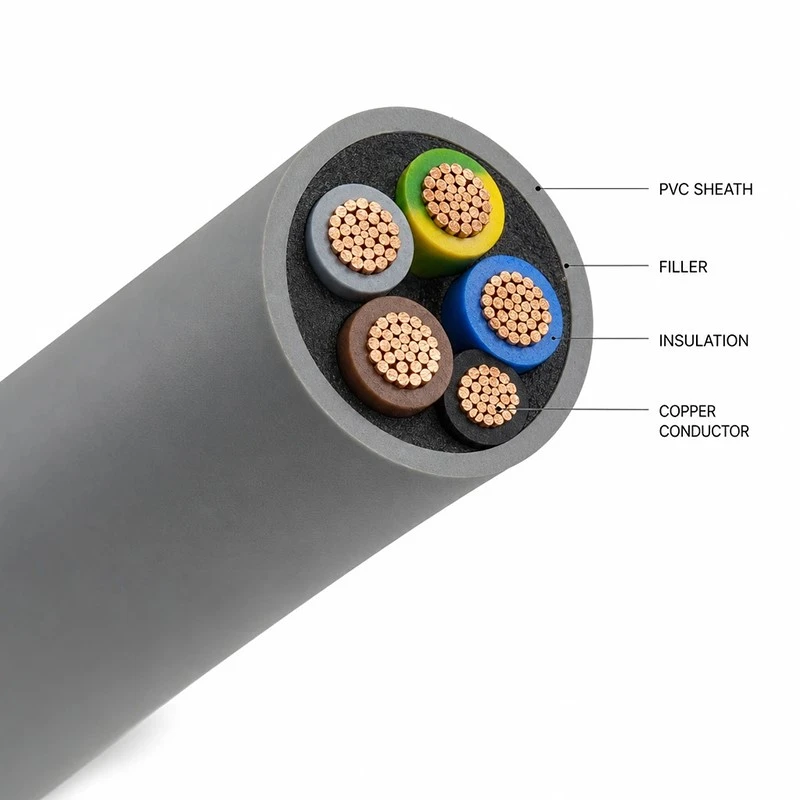
Technical evaluations of these cables in industrial settings focus on three key dimensions: bending resistance, which depends on conductor stranding techniques and TPU jacket materials; temperature adaptability, achieved through a design capable of withstanding a wide range from -40°C to 80°C; and customization capabilities, reflected in adjustable shielding coverage and torsion-resistant structures. Differences between brands often lie in the level of sophistication applied to these specific details.
In practical applications, automation equipment manufacturers prioritize the cable's service life during reciprocating motion. High-frequency bending scenarios necessitate specialized stress-relief structures, whereas multi-axis coordinated systems require addressing potential crosstalk between cables. These demands have directly driven the standardization of features such as dual-shielding and high flexibility.