Nov 18, 2026

Choosing Control, Signal and Drag Chain Cable

Leave a message

A control cable, a signal cable and a drag chain cable are often asked for in one sentence and quoted from three different sheets. One is priced by cores and cross-section, one by pairs and screening, one by travel and bend factor. None of the three names a product family on its own.
 
The words do not describe three product families. Two describe what the circuit carries; the third describes how the cable moves. That is where most specification errors begin. Leave the motion out of an enquiry and the reply can only be a fixed-installation price - the first failure then happens at the cable carrier, not in the quotation. Leave the screening out and the cheapest compliant reply will be unshielded - the interference appears after commissioning, when the cable is already pulled.


What follows is five decisions in a fixed order. Each one produces an output that the next one depends on, and each ends with what it costs to get it wrong.
 
Step
The question you answer
What it fixes
Output
1
What does the circuit do?
Conductor, core or pair count, voltage class
Control or signal; 300/500 V or 300 V
2
How is it installed?
Stranding, bend radius, jacket compound
Fixed, occasional, continuous or torsion

3

How is it installed?
Screening step and who terminates it
Unshielded, foil, braid, or both
4
What does the site contain?
Jacket family
PVC, PUR, TPE or halogen-free
5
What will you accept against?
Documents
A certificate that names the construction
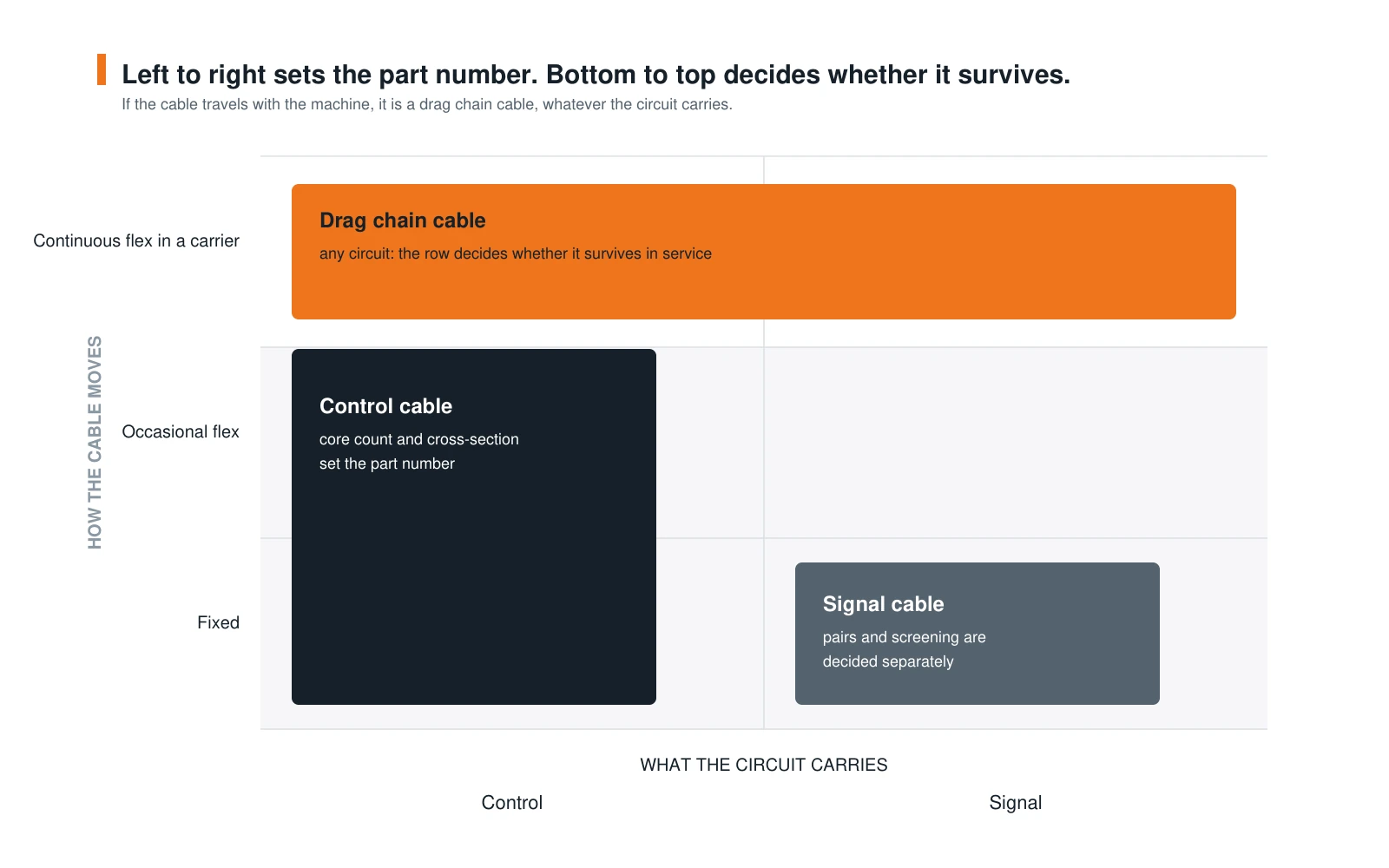
Steps 1 and 2 decide the part number. Steps 3 to 5 decide whether that part number survives the site and the audit.
 

Matrix of circuit function against cable motion placing control and signal cables by the row they must survive

Step 1 - Function Sets the Conductor, the Voltage Class and the Price


Control, signal and power are separated by what the conductor is asked to do, not by how the cable looks. If the circuit is judged by whether it switched, it is a control cable. If it is judged by whether the number is still right, it is a signal cable.
 
  • A control cable switches states: a contact closes, a relay picks up, a drive is enabled. Current is small, but the circuit switches often, so the conductor is stranded for bending rather than for current. Core counts are high relative to cross-section - a panel may need eight, twelve or twenty cores in one run - and the cable is priced by cores ×cross-section.
 
  • A signal cable carries a value that changes continuously: a 4–20 mA loop, a thermocouple, an encoder pulse train. Current is tiny, and the enemy is noise and capacitance rather than voltage drop. Conductors are often paired, sometimes individually screened, commonly 0.14–1.0 mm², and the cable is priced by pairs × cross-section plus the screening step.
 
  • A power cable carries energy. Current is high, the cross-section comes from load and volt drop, and the pricing unit is a single cross-section.
 
  • Voltage class is the second decision inside Step 1. In our range the control cables are built to 300/500 V and the signal cables to 300 V or 300/500 V. A 300/300 V cable and a 300/500 V cable are not interchangeable in a circuit specified against the higher class, even when the copper is identical - and the difference is not visible on the drum.
 
  • Sizing follows the same logic. Signal size is set by two constraints: voltage drop over the run, and the capacitance of the pair against the signal frequency. Control size follows the terminal it lands in and the current it switches; 0.5–2.5 mm² covers most machine wiring.
 
Protocol cable is a third question: Fieldbus Cables and Industrial Ethernet Cablesare specified by impedance and pairing, not by core count. Three of our ranges cover these three functions: Control Cables , Signal Cables and Drag Chain Cables.
 
Get the function wrong and the same copper is quoted against two different test voltages. The cheaper sheet is not the same cable, and the difference only shows at acceptance.
 

Step 2 - The Installation Sets the Construction


This step changes the part number, and it settles the question buyers most often get wrong: if the cable travels with the machine, it is a drag chain cable, whatever the circuit carries. Step 1 still decides the conductor and pair count inside it. Four classes:
01
Fixed. Installed once, clamped, no movement after commissioning. The radius is taken once, at installation
 
02
Occasional flex. Movement during maintenance or a setup change - hundreds of cycles over life, not millions. Many "flexible" cables are specified for this class and then run in a carrier, which is where the life expectation breaks.
 
03
Continuous flex. The cable travels with the machine for the life of the equipment. This is a different construction, not a softer version of the same one.
 
04
Continuous flex. The cable travels with the machine for the life of the equipment. This is a different construction, not a softer version of the same one.
 
Four numbers belong in the enquiry: radius, travel, speed and acceleration, and target cycles. Cycle count is the one most often left out, and it decides whether the cable lasts a year or ten.
 
Radius has two bases. In our drag chain range the minimum bending radius is 5 × OD fixed and 8 × OD moving. The two are not interchangeable - a cable installed at the fixed value and then run in a carrier is outside its own specification. Read the radius per series, not per supplier
 
The construction changes with the motion. The conductor is re-stranded, a centre element may carry tension so the conductors do not act as a rope, the braid angle is changed to survive the bend, and the compound is chosen for abrasion rather than price. "Softer PVC" is not a construction answer.
 
The construction changes with the motion. The conductor is re-stranded, a centre element may carry tension so the conductors do not act as a rope, the braid angle is changed to survive the bend, and the compound is chosen for abrasion rather than price. "Softer PVC" is not a construction answer.
 
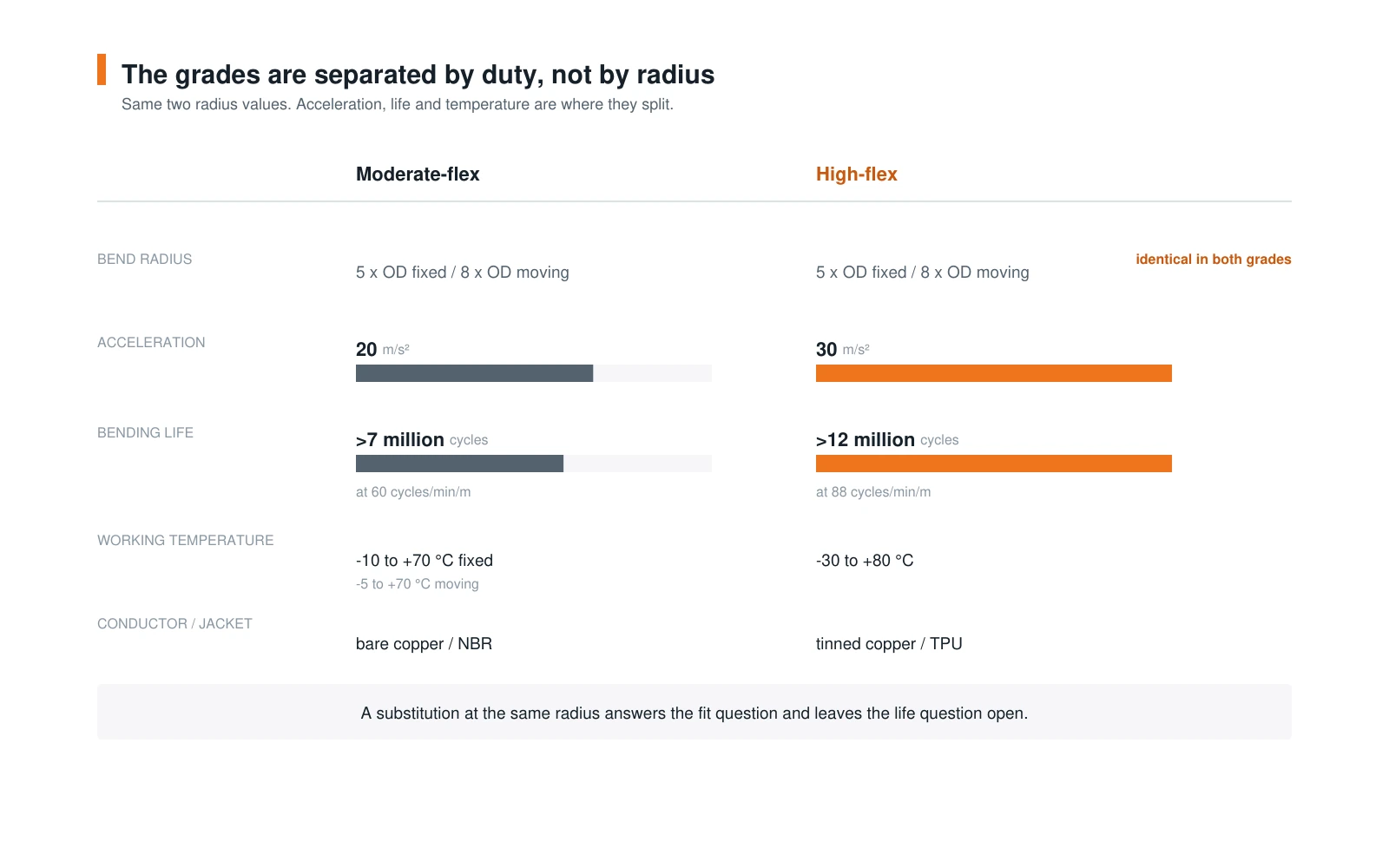
Item Moderate-flex grade High-flex grade
Rated voltage 300/300 V ≤0.5 mm², 300/500 V >0.5 mm² Same
Minimum bend radius 5 × OD fixed / 8 × OD moving 5 × OD fixed / 8 × OD moving
Travel acceleration 20 m/s² 30 m/s²
Bending life >7 million cycles at 60 cycles/min >12 million cycles at 88 cycles/min
Working temperature –10 to +70 °C fixed; –5 to +70 °C moving –30 to +80 °C
Conductor / jacket Fine bare copper / NBR Fine tinned copper / TPU polyether
Where it fits Fixed and occasional-flex runs, plus carrier duty at moderate acceleration and cycle counts Continuous flex at high acceleration and long cycle counts
Main advantage Lower cost per metre with an NBR jacket; the default answer for panel and machine wiring Higher acceleration and cycle life, with a TPU jacket for abrasion and target cycles
Key limit Continuous flex at high acceleration is outside its rating Costs more per metre and buys nothing on a fixed run
What the drawing must state 5 × OD fixed / 8 × OD moving, travel and target cycles 5 × OD fixed / 8 × OD moving, travel, acceleration and target cycles


If the motion is not written in the enquiry, the reply can only be a fixed-installation price - and the first failure will be at the cable carrier, not in the quotation.
 
Moderate-flex and high-flex drag chain grades compared by acceleration cycle life and temperature at one bend radius

Step 3 - Interference Sets the Screening Step
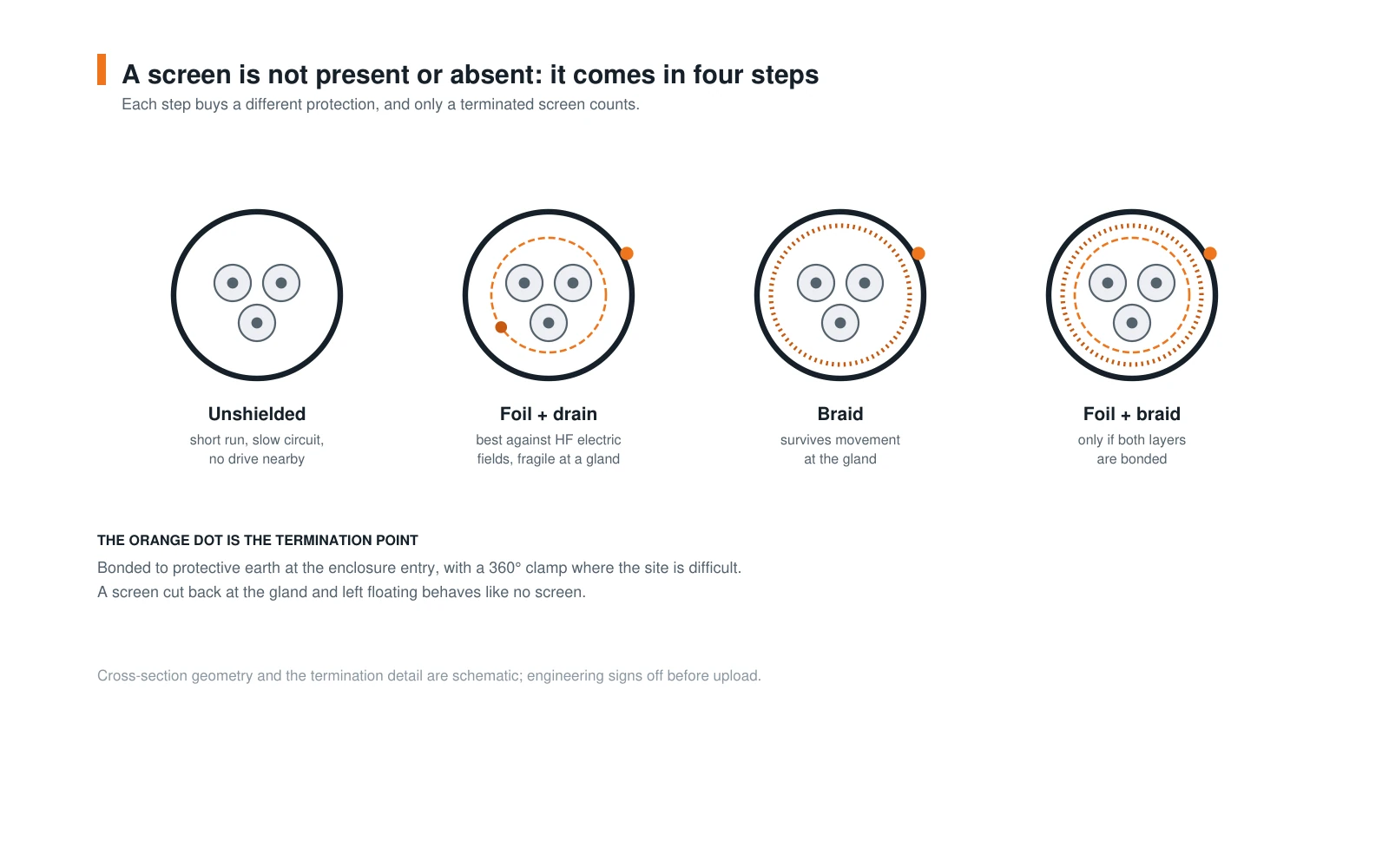


A screen is not present or absent. It comes in four steps, and each buys a different kind of protection. If a drive shares the duct for more than a few metres, start at braid. If the run is short and stays inside one enclosure, unshielded is the default.


Unshielded is adequate when the run is short, the circuit slow and no drive is nearby. Most wiring inside a single enclosure works here.


Foil with a drain wire is aluminium foil on a polyester tape, with a tinned copper drain wire in contact. It is good against
high-frequency electric fields, poor against low-frequency magnetic fields, and fragile where it is bent repeatedly at a gland.


Braid is tinned copper over the cores. Lower high-frequency coverage than foil, but far more robust, and survives
movement at the gland.


Foil plus braid uses both, where the environment is genuinely noisy and the circuit genuinely sensitive. Cost and
terminating work rise, and the benefit appears only if both layers are bonded.


Pairs are a separate decision. Pairing cancels the field that couples into the loop; a screen blocks the field from arriving. A twisted pair without a screen often beats a screened cable with parallel conductors, and the two are usually combined rather than substituted.


Termination decides the result. A screen cut back at the gland and left floating behaves like no screen. The braid or drain wire must be bonded to protective earth at the enclosure entry, with a 360° clamp where the environment is difficult. This is installation work, and it is the step most often missing from a quotation.
What a screen does not fix: a low-frequency magnetic field from a motor cable running parallel for several metres.Distance and steel armour work on that problem; copper braid does not.


Shielding changes both the price and the terminating work. A shielded cable installed with the foil cut back at the gland performs like an unshielded one - the money was spent, the protection was not.


Cross-sections of unshielded foil-plus-drain braided and foil-plus-braid cable with the screen termination point marked

Step 4 - The Site Sets the Jacket


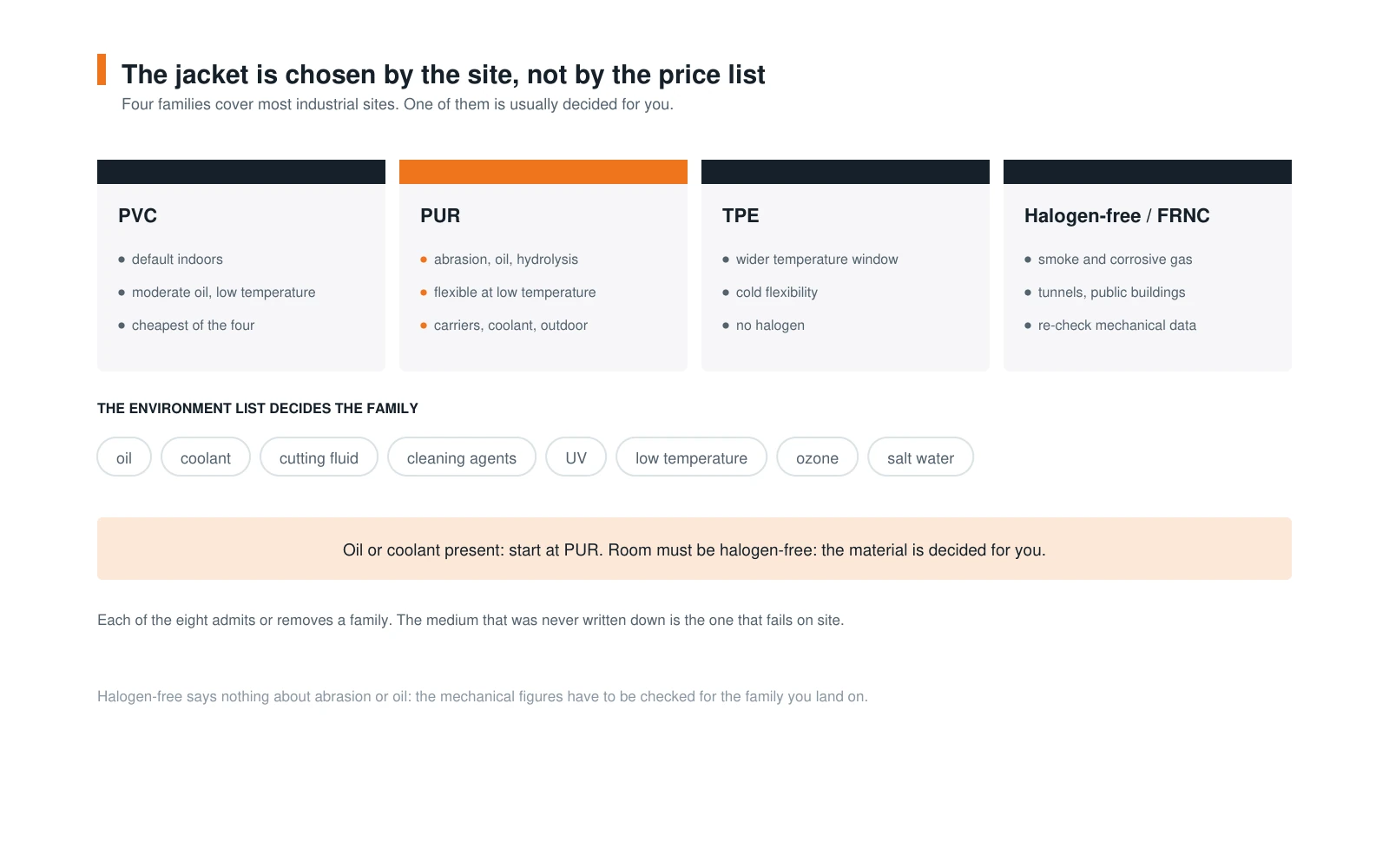
The jacket is chosen by the site, not by the price list. Four families cover most of what an industrial buyer meets. If oil or coolant is present, start at PUR. If the room must be halogen-free, the material is decided for you.
 
PVC is the default: adequate indoors, moderate oil and low-temperature behaviour, and the cheapest of the four. It is also the family most often specified by habit rather than by requirement.

01

PUR is abrasion, oil and hydrolysis resistant, and flexible at low temperature. It is the usual answer for carriers, machine tools with coolant, and outdoor equipment that moves. The cost step is real and is normally recovered in the first avoided replacement.

02

TPE offers a wider temperature window than PVC, good cold flexibility and no halogen. It is used in cold stores, or where the fire requirement rules out PVC.

03

Halogen-free / FRNC is chosen for smoke and corrosive gas, not for flexibility: tunnels, public buildings, enclosed rooms
with people and electronics. The mechanical figures have to be re-checked, because "halogen-free" says nothing about abrasion or oil.

04

The environmental list is short and decides the family: oil, coolant, cutting fluid, cleaning agents, UV, low temperature, ozone and salt water. Each one admits or removes a family; a jacket that passes the factory test and fails on site usually met something that was never written down.


What the jacket does not do: carry tension, or correct a radius that is too tight. A better compound will not compensate for either.
 
A jacket that fails on site usually passes the factory test. The environment has to be named in the enquiry, not discovered after installation - and the cost of discovering it is paid in downtime, not in the price per metre.
PVC PUR TPE and halogen-free jacket families with their limits above the eight site conditions that decide between them

Step 5 - The Document Sets Acceptance


A cable is accepted against a document, not against a description. Four kinds of paper matter, and they answer different questions. If the certificate names only the family, acceptance evidence does not exist yet.
 
  • Construction standards. EN 50525 covers the European harmonised range; IEC 60227 covers PVC-insulated cables of the 450/750 V class and below; GB/T 3956 defines the conductor classes used in our control and signal ranges. The standard says what the cable claims to be. It does not say that the drum in front of you was tested to it - that is what the test report is for.
 
  • North America. A UL AWM Style number identifies a construction category, not a recognition status. The style number and the UL file for the actual manufacturer are two different pieces of evidence, and an inspector asks for the second.
 
  • Europe. CE is a compliance marking, not a cable type; an H-code is a harmonised designation, not a CE certificate. A cable can carry an H-code and still need a declaration of performance.
 
  • The certificate's subject. A certificate that names a family opens a question about the construction; one that names the construction and the manufacturer is evidence, and the difference is paid at acceptance.
 
A certificate that names a family rather than a construction is a starting point for a question, not an answer - and the gap is paid for in downtime, not in the price per metre.


Three Cases, Start to Finish


Machine panel, fixed wiring, no drive nearby.

Control cable, unshielded, 300/500 V, 0.5–1.5 mm², PVC. Steps 1 and 2
settle it; Step 3 confirms no screen is needed.

Load cell or analogue loop, with a drive in the same duct.

Signal cable, twisted pairs, braid screen, PUR if coolant is present. Step 1 gives pairs and voltage class; Steps 3 and 4 give screen and jacket.

Tool carriage or robot axis.

Drag chain cable at 5 × OD fixed and 8 × OD moving, the grade chosen by acceleration and cycles rather than radius. Step 2 decides almost everything.

Before You Send the Enquiry


- Circuit function: switching, measuring, or energy.
- Voltage class and the test voltage the drawing calls for.
- Core or pair count, and cross-section.
- Screening step, and who terminates the screen.
- Installation class and the four motion numbers.
- Jacket family and the media it will meet.
- Approval, and the documents required with delivery: certificate of conformity, test report, RoHS/REACH declaration.


Mistake What it costs How to catch it
Choosing the letter first, then the duty A second order, and the schedule moves to the back of the queue Compare the duty class against the four motion numbers before the part number is quoted
A fixed construction run in a carrier An unplanned stop, usually after the warranty conversation Ask for the cyclic-flex rating in writing; a sheet with none is not a carrier cable
Treating "shielded" as "Immure" Paid for the screen, got unshielded performance Inspect the termination at the gland: a floating screen is no screen
Leaving the motion out of the enquiry The lowest complaint step is quoted; two cables are compared Put radius, travel, speed, acceleration and cycles in every RFQ


Not sure which construction fits your application?
Send the cable and connector specifications for a technical review.

Review My Requirement

FAQ


Q: Is a control cable the same as a signal cable?

A: No. They can look identical and are judged differently: one by whether the circuit switches, the other by whether the value stays accurate. A screened control cable sometimes serves as a signal cable, but that is a construction check, not a category rule.

Q: What size signal cable do I need?

A: Volt drop sets the minimum cross-section; pair capacitance against frequency sets the maximum length. For most 4–20 mA and encoder runs, 0.14–0.75 mm² is the working range.

Q: Can a fixed-installation cable be used in a drag chain?

A: It will conduct and it will fail earlier than the cycle count suggests. The jacket usually outlives the conductor, so the fault appears as an intermittent signal rather than a visible break.

Q: Can one grade replace another at the same cross-section?

A: Not on the strength of the radius. Both grades share 5 × OD fixed and 8 × OD moving; acceleration, cycle life and temperature are where they separate, so a substitution answers the fit question and leaves the life question open.

Q: Can we start from an existing sample?

A: A dimensioned sample or a photo can start the review, and it settles fit. It does not settle acceptance: the length datum, the pinout and the standard still have to be written down.


Need Help Specifying the Cable?


Send the drawing or the duty, and we will check the construction against it before quoting:
1. KABASI cables - our own control, signal and drag chain ranges, cut to length.
2. Customer-specified cable brands - we purchase the brand named on your BOM and confirm availability and
documents for the exact item.
3. Customer-supplied materials - you send the cable, we cut, terminate and test.
  • First action: send the four motion numbers - bend radius, travel, speed and acceleration, target cycles - with the existing part number. We will return a construction comparison, not a price alone, within 2 working days.


Finished assemblies are quoted with the cable as one item, not as a second transaction: Cable Assemblies.


Send Inquiry