

Two systems, one question
| Dimension | UL AWM Style | European Harmonized Code |
| Published by | UL, under UL 758 | CENELEC - designation system in HD 361, constructions in the EN 50525 series |
| What the designation is | One number per approved construction | Fixed positions, each with one meaning |
| What it fixes | Temperature and voltage rating, conductor size range, insulation material and minimum wall, flame test, marking, intended use | Voltage class, insulation and sheath material, screen, cable form, conductor class, core count, cross-section |
| Who stands behind it | Recognised Component status, re-evaluated inside the end product | HAR scheme plus national certification bodies; the harmonized mark is printed on the sheath |
| What it leaves open | Wall thickness within a voltage class, AC and DC as separate ratings, optional jacket and screen, whether this supplier holds the style | Reaction-to-fire class, oil resistance unless coded, core-colour edition, which body certified it |
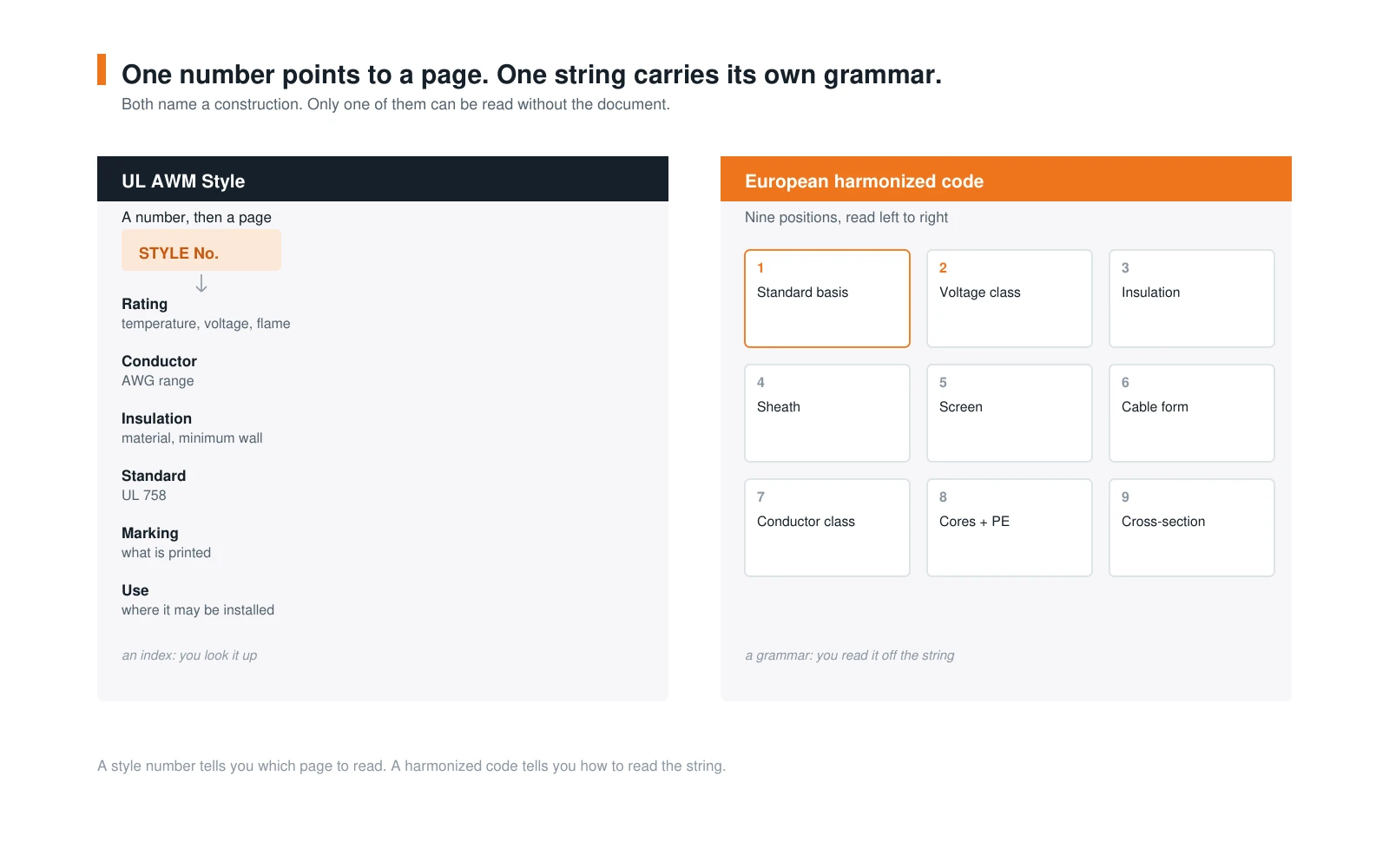
What an AWM Style number tells you
The page behind a Style number carries six lines, and each one can be quoted wrong.
the rating, meaning temperature voltage and flame test
the conductor range in AWG
the insulation material with a minimum wall
the standard the construction is evaluated against
| Leading block | Construction |
| 1000–1999, 10000–19999 | Single conductor, thermoplastic insulation |
| 2000–2999, 20000–29999 | Multiconductor, thermoplastic insulation and jacket |
| 3000–3999 | Single conductor, thermosetting insulation |
| 4000–4999 | Multiconductor, thermosetting insulation and jacket |
| 5000–5999 | Specialty items, single and multiple conductor |
What an AWM Style number does not tell you
Wall thickness inside a voltage class
Alternating and direct current are separate ratings
Jacket and screen are not implied
Whether this manufacturer holds the style
What a harmonized cable code tells you
| Position | Decides | Does not decide |
| Standard basis | Whether the cable is harmonized or built to a national standard | Any construction detail |
| Voltage class | Rated voltage - 300/300 V, 300/500 V, 450/750 V | Temperature rating |
| Insulation material | The compound and its temperature band; ordinary PVC and higher-temperature PVC are different values | Wall thickness |
| Sheath material | The sheath compound; oil-resistant PVC is its own value | Sheath colour |
| Screen | Whether a copper braid screen is present | Coverage or transfer impedance |
| Cable form | Round or flat, separable or not | Outer diameter |
| Conductor class | Solid, stranded or fine wire | Current carrying capacity |
| Core count and protective conductor | Circuit organisation, presence of an earth core | Cross-section |
| Cross-section | Current capacity and terminal size | Conductor class |
What a harmonized cable code does not tell you
Reaction to fire, where it applies
01
Oil resistance
02
Which edition of the core colour convention the cores follow.
03
Which body certified it, and to which part of EN 50525.
04
Sheath colour and marking
Grey, black and orange can all be the same designation.
05
One quotation, one missing position
- The expensive designation errors do not look like errors on the quotation.
- A drawing calls for a 300/500 V PVC sheathed flexible cord, five cores including a protective conductor, for a machine exported to Europe. The quotation returns a cord of the same family, the same five cores, the same sheath colour, at a lower price. Nothing on the paper contradicts the drawing.
- At incoming inspection the sheath print shows 300/300 V. The cable is not defective. It is a different voltage class in the same family, and the machine's rating, nameplate, terminal selection and declaration all have to follow the lower figure.
- Nobody misread a letter; a position that carries the voltage was never compared.
- The same shape appears with the conductor class: a fine-wire core quoted where a solid core was drawn, and a terminal that no longer closes on it. In both cases the quotation was not wrong about the cable; it was incomplete about the construction.
Four ways a cable designation gets misused
| Misuse | What it looks like | How to verify |
| The designation alone | A quotation that repeats the code and omits size, wall, screen and core colour has repeated a word, not quoted a cable. | Ask for the construction in writing - conductor class and size, core count, screen, sheath material, form. If the sheet cannot name them, the code alone is not a quotation. |
| One column of a dual rating | A cable that carries a harmonized rating and an AWM rating carries them at different voltages and temperatures. The column that applies is the one for the market the machine is sold into, not the higher of the two. | Take the market the machine is sold into, then read that column's voltage and temperature off the sheath print at incoming inspection. |
| Compatibility written as interchangeability | The two are not the same claim. Similar construction and similar ratings make two cables compatible for a review; they do not make them interchangeable, and only a parameter-by-parameter comparison decides that. | Put the four comparison items side by side - voltage basis, temperature basis, flame test method, scope of evaluation - before the word "equivalent" is used. |
| CE treated as a cable type | CE is a compliance marking within the scope of a directive. It is not a construction and does not replace a designation. | Read the declaration's directive scope and the designation separately; one does not evidence the other. |
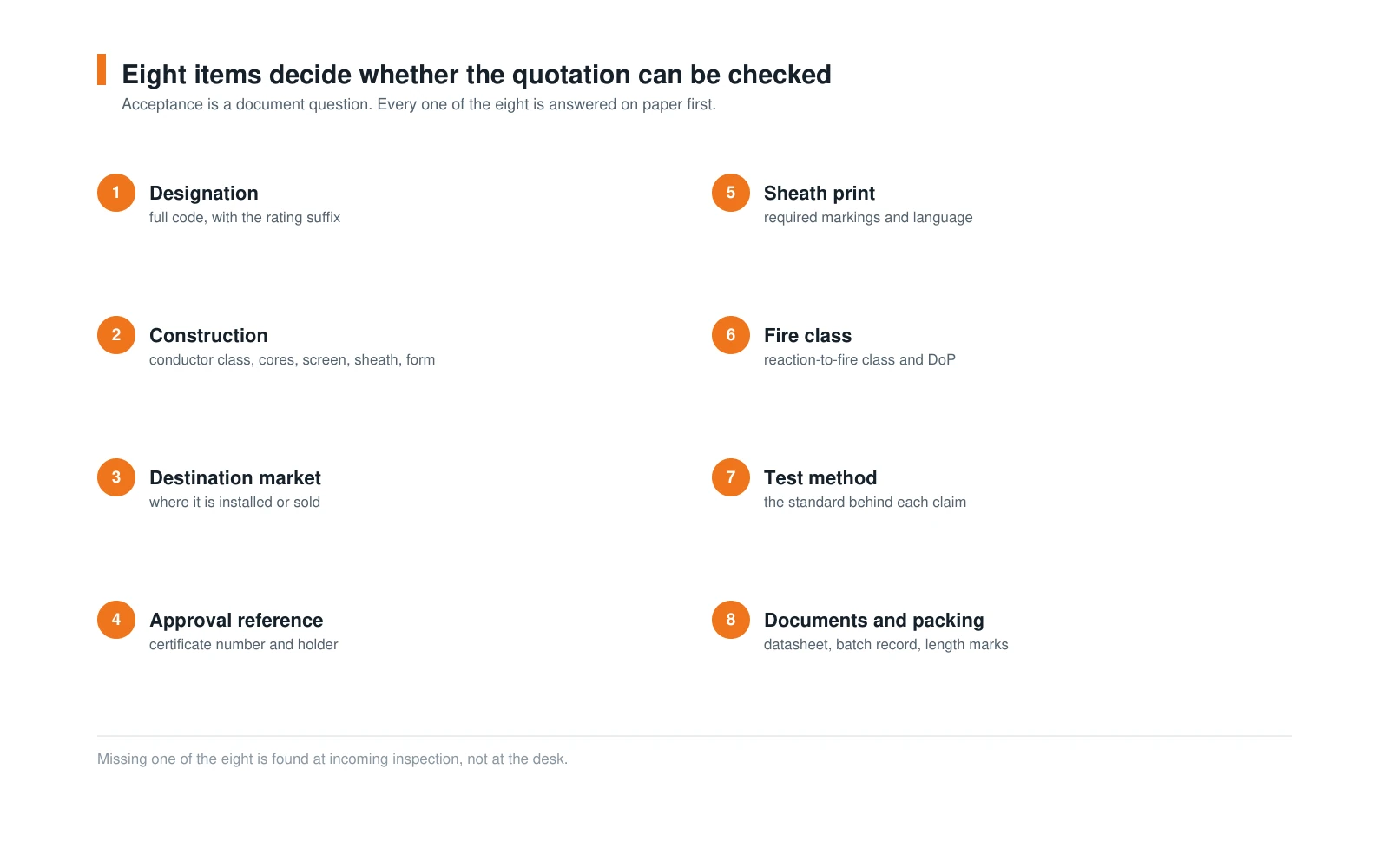
What to send with an inquiry
| Item | What to state | Why it changes the answer |
| Designation | Full designation with the rating suffix | A bare code leaves the rating to the supplier |
| Construction | Conductor class and size, core count, screen, sheath material, form | These four are not carried by the number |
| Destination market | Country of installation or sale | Decides which rating column applies |
| Approval reference | Certificate number and holder | A number without a holder cannot be verified |
| Sheath print | Required markings and language | Decides whether the delivered reel can be accepted on sight |
| Fire class | Reaction-to-fire class and Declaration of Performance, where the cable is installed in a building | Sits outside the designation |
| Test method | The standard behind each flame and oil claim | Three flame tests are not one test |
| Documents and packing | Datasheet, batch test record, RoHS/REACH, length marks | Decides traceability at the lot level |
FAQ
Q: Does a UL Style number mean the cable is UL Listed?
A: No. Appliance wiring material is a recognised component category under UL 758. The cable is evaluated as a component, and the end product is listed with it inside. The distinction decides who is responsible for what at machine level.
Q: Is a harmonized code the same as CE marking?
A: No. The code names a construction; CE is a marking tied to a directive and, for cables permanently installed in buildings, to a Declaration of Performance. A cable can carry one without the other.
Q: Can an AWM cable replace a harmonized cable in a European panel?
A: Not on the strength of the numbering. The two systems differ in voltage basis, temperature basis, flame test method and scope of evaluation. A replacement is a documented comparison, parameter by parameter.
Q: Why do two cables with the same designation carry different temperatures?
A: Because the temperature usually sits in a material position or in a rating column the designation does not print, and a dual-rated cable carries one temperature for the harmonized rating and another for the AWM rating.
Q: Which documents should I ask for before approving a substitute?
A: A datasheet with the full construction, the approval reference and its holder, the test report behind each flame and oil claim, the Declaration of Performance wherever the cable is installed in a building, and the batch test record for the delivered lot.
Where to go next