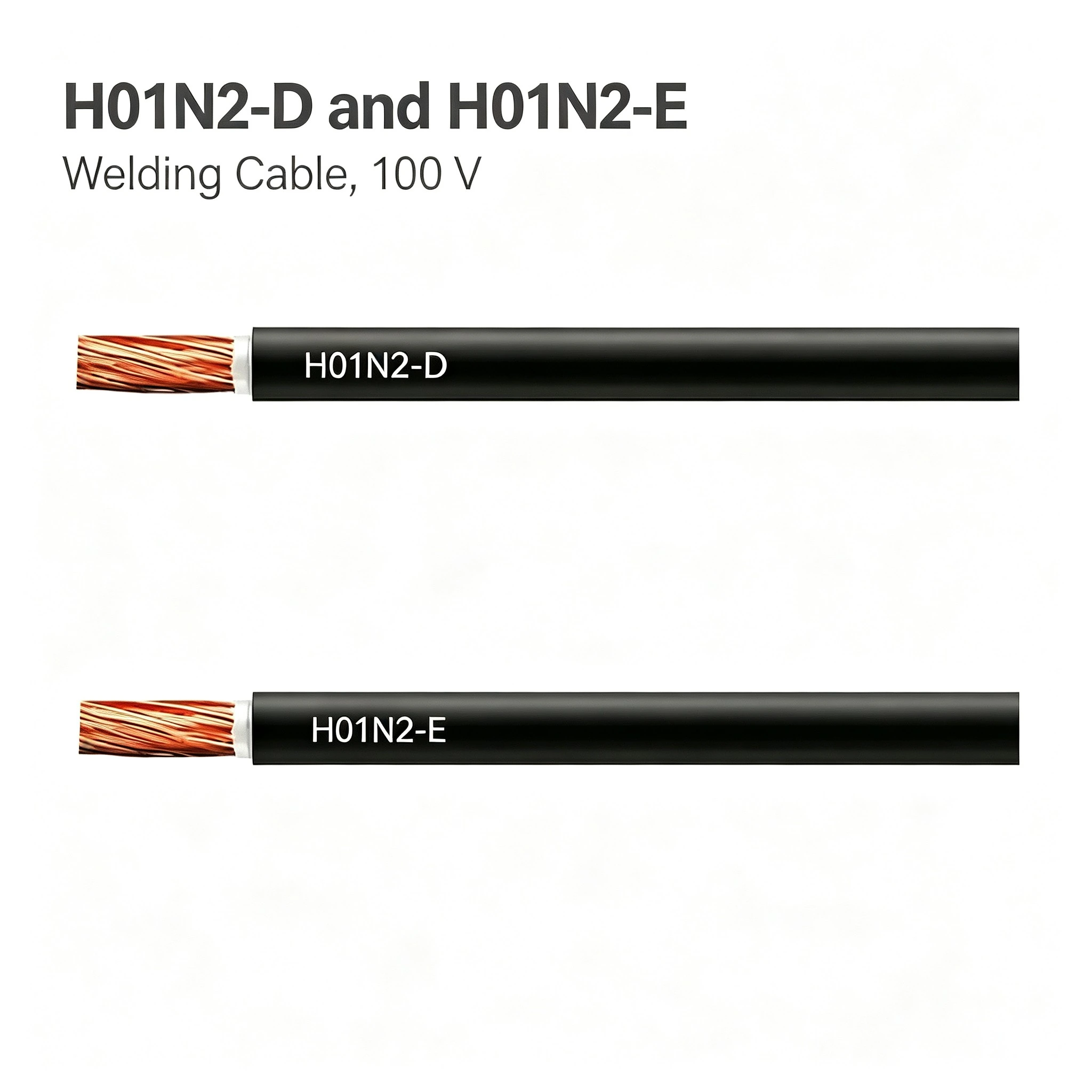
Xiamen Kabasi Electric Co., Ltd. is one of the most reliable manufacturers and suppliers of h01n2-d and h01n2-e welding cable, 100 v in China. If you're going to buy bulk durable cables made in China, welcome to get pricelist from our factory. All customized cables are with high quality and competitive price.
What a Welding Circuit Demands of Its Cable
A welding lead carries the arc current in one direction and the return current in the other, and it does that while being dragged over steel, coiled around a hook and stepped on. Four properties follow from that duty.
| Requirement | How this cable answers it |
| Conduct the arc without a voltage drop that reaches the weld | Bare copper, extra-fine strand to DIN VDE 0295, BS 6360 and IEC 60228; the copper weight per kilometre is printed for every size so a run can be sized against its length |
| Strip cleanly after a heat cycle | A separator is fitted over the conductor, so the sheath does not bond to the copper and the end can be prepared without nicking strands |
| Survive spatter, oil and daylight | Chloroprene outer sheath, chlorinated rubber type EM5, in black; tested to DIN EN 60811-404 for oil resistance |
| Stay flexible where the operator bends it | Fine and extra-fine stranding, with a minimum bending radius tied to the grade - 12 x outer Ø for the standard build, 10 x for the extra-flexible one |
| Hold up to flame at the joint | Flame tested to DIN VDE 0482-332-1-2, DIN EN 60332-1-2 and IEC 60332-1 |
Two Grades of the Same Cable - D and E
Both grades share the conductor material, the separator and the sheath compound. What separates them is the strand diameter, and through it the diameter, the weight and how tightly the cable can be bent.
| H01N2-D standard flexible | H01N2-E extra-flexible | |
| Copper wire | 0.2 mm up to 95 mm², 0.5 mm from 120 mm² | 0.15 mm up to 95 mm², 0.2 mm from 120 mm² |
| Outer Ø at 1 x 10 mm² | 7.7 – 9.7 mm | 6.2 – 7.8 mm |
| Outer Ø at 1 x 25 mm² | 10.1 – 12.7 mm | 8.6 – 10.8 mm |
| Weight at 1 x 10 mm² | 135.0 kg / km | 119.0 kg / km |
| Minimum bending radius | 12 x outer Ø | 10 x outer Ø |
| Where it belongs | Torch leads on fixed stations and straight runs to the clamp | Hand-held guns, robotic torches and any lead that is re-bent every cycle |
The two grades overlap in the middle of the range and separate at the ends: E reaches down to 10 mm² and stops at 185 mm², while D runs the full range to 240 mm². Where a gun is passed hand to hand all shift, the extra strand count is what decides how long the lead lasts.
Typical Applications
Welding cable runs between the generator and the electrode holder, and between the workpiece clamp and the generator, in any shop where the work moves.


FAQ
Q: Can the two grades be mixed on one machine?
A: Yes. They share the conductor material, the separator and the sheath, so D and E terminate the same way. Use E where the lead is handled and D where it is fixed.
Q: How do I read the outside diameter on the schedule?
A: Each size is printed as a minimum to maximum range, because the sheath thickness varies with the run. Size a gland or a lug against the maximum, and check the minimum against the bending radius you need.
Q: What does the number of copper wires mean?
A: It is a guide value, not a mandatory count. What governs the conductor is the cross-section in mm²; the wire count tells you the strand diameter and therefore the flexibility of that size.
Hot Tags: h01n2-d and h01n2-e welding cable, 100 v, China h01n2-d and h01n2-e welding cable, 100 v suppliers
Electrical and Thermal Values
| Parameter | H01N2-D | H01N2-E |
| Rated voltage U0/U | 100/100 V | |
| Test voltage | 1000 V | |
| Temperature range, moving | −25 °C to +80 °C | |
| Temperature range, fixed | −40 °C to +80 °C | |
| Permissible conductor temperature | +85 °C | |
| Minimum bending radius | 12 x outer Ø | 10 x outer Ø |
Construction and Materials
| Parameter | H01N2-D | H01N2-E |
| Conductor | Bare copper, extra-fine strand, to DIN VDE 0295, BS 6360, IEC 60228 | |
| Conductor build | 0.2 mm wire up to 95 mm²; 0.5 mm wire from 120 mm² | 0.15 mm wire up to 95 mm²; 0.2 mm wire from 120 mm² |
| Separator | Fitted over the conductor | |
| Outer sheath | Chloroprene rubber, chlorinated rubber type EM5 | |
| Sheath colour | Black | |
| Earth marking | Without green-yellow marking | |
Fire, Oil and Service Conditions
| Parameter | Rating |
| Flame test | DIN VDE 0482-332-1-2, DIN EN 60332-1-2 / IEC 60332-1; equivalent to DIN VDE 0472 part 804, test method B |
| Oil resistance | DIN VDE 0473-811-404 / DIN EN 60811-404 |
| Environmental resistance | Keeps its high flexibility under ozone, light, oxidation, inert gas, oil and petrol |
| Application environment | Open air as well as dry and damp locations |
| Approval | VDE; EAC; CE to Low Voltage Directive 2014/35/EU |
| Conductor count | The number of copper wires is a guide value; no fixed count is mandatory |
| Options | Tinned copper on request |
| Cross-section | AWG values are approximate; the effective cross-section is stated in mm² |