

Xiamen Kabasi Electric Co., Ltd. is one of the most reliable manufacturers and suppliers of ul1061 / ul1569 / ul10368 — 300 v single-core wire in China. If you're going to buy bulk durable cables made in China, welcome to get pricelist from our factory. All customized cables are with high quality and competitive price.
Lead Paragraph
The 300 V range has one default, UL1007: 32 to 16 AWG, 80 °C, a 0.38 mm PVC wall. These three Styles are what sits either side of it. UL1061 takes the conductor to 14 AWG on a thinner wall of 0.23 to 0.32 mm. UL1569 takes it to 10 AWG and states three temperature ratings, 80, 90 and 105 °C, at the same 300 V. UL10368 leaves PVC altogether: 105 °C, XLPE, 0.25 mm nominal wall, 32 to 10 AWG. They are grouped because each answers a question the default cannot - a thicker conductor, a heavier conductor, a hotter interior - and because all three keep the same 300 V rating.
Three Questions the 32 to 16 AWG Window Cannot Answer
The three Styles are not substitutes for one another, and they are not a ladder of quality either. Each one removes a single constraint, and the constraint it removes is the only reason to move off the default.
UL1061 removes the top of the size range and part of the wall: it reaches 14 AWG and does so with 0.23 to 0.32 mm of insulation rather than 0.38 mm, which matters where the terminal is tight. UL1569 pushes the top of the range to 10 AWG - while adding 90 and 105 °C to the 80 °C entry. UL10368 removes the temperature ceiling: at 105 °C it swaps PVC for XLPE, and the XLPE wall is 0.25 mm, so the finished core is slimmer than a PVC core of the same conductor.
Where These Three Are Specified: Tight Terminals, Heavy Runs, Hot Cabinets
Still 300 V, still inside the equipment, but the default PVC core no longer fits. UL1061 is ordered when the run ends in a 14 AWG conductor on a thin SRPVC wall; UL1569 when one PVC construction has to hold 80, 90 or 105 °C and carry a heavy feed up to 10 AWG; UL10368 when the cabinet sits at 105 °C and the cores share a duct, where 0.25 mm of XLPE keeps the diameter down.

Why These Three
Thin wall, 14 AWG
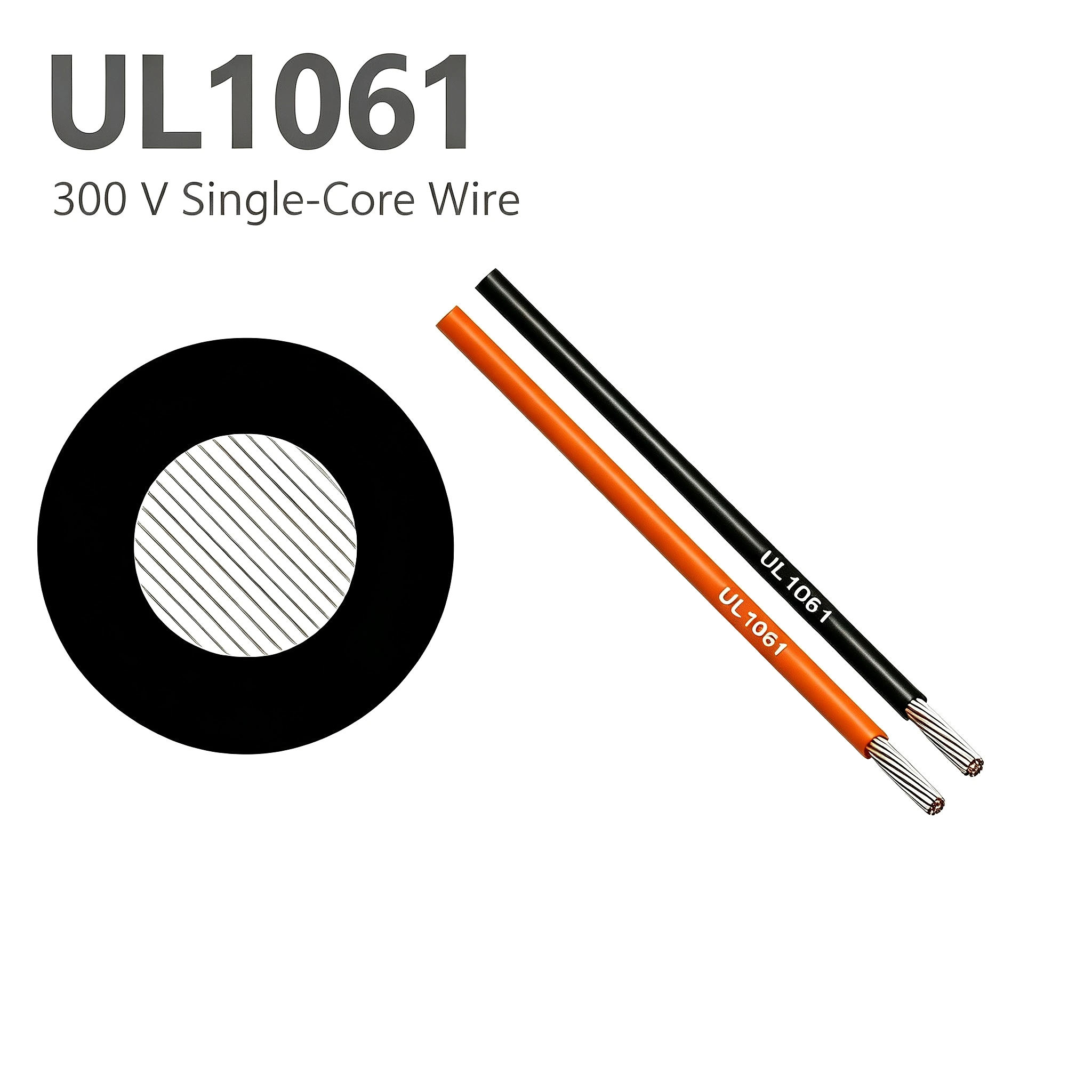
UL1061 runs from 30 to 14 AWG with a nominal insulation thickness of 0.23 to 0.32 mm, against 0.38 mm on the default. The thinner wall is what makes 14 AWG usable in a terminal that was sized for a smaller conductor, and the finished diameter grows more slowly as the conductor goes up. Resistance at 14 AWG is 8.61 Ω/km, which is the figure a voltage-drop check needs at that size.
10 AWG, three ratings
UL1569 is the only one of the three that carries three temperature ratings - 80, 90 and 105 °C on the same PVC construction - and it spans 30 AWG to 10 AWG. One Style therefore covers both ends of a job: light control wiring at the fine end, and a 10 AWG internal feed at 300 V at the other, with the upper ratings available where the cabinet runs above 80 °C.
XLPE at 105 °C
UL10368 changes the compound rather than the voltage: XLPE instead of PVC, 105 °C instead of 80 °C, and a 0.25 mm nominal wall instead of 0.38 mm. The dielectric figure is 1500 VAC for one minute on the fine sizes and 2000 VAC on the rest, and the conductor schedule runs 32 to 10 AWG. For the same conductor the core is slimmer and bends more easily inside a crowded enclosure, at the higher temperature.
FAQ
Q: Why are these three grouped?
A: Because each one carries the 300 V duty outside the 32 to 16 AWG, 80 °C, 0.38 mm window of the default Style, and none of them carries it in the same way: one goes to 14 AWG on a thin wall, one goes to 10 AWG across three temperature ratings, and one changes the insulation compound to reach 105 °C.
Q: UL1061 or UL1007?
A: By wall thickness and by the 14 AWG end. UL1007 is 0.38 mm over 32 to 16 AWG; UL1061 is 0.23 to 0.32 mm over 30 to 14 AWG. Both are 300 V and 80 °C, so the decision is whether the design needs the thinner wall or the heavier top end.
Q: UL1569 or UL1015?
A: By voltage, not by size. Both reach a heavy conductor, but UL1569 holds 300 V and UL1015 holds 600 V, on a schedule that goes to 2000 kcmil. Where the circuit is 300 V, UL1569 is the correct member of the family.
Q: What does XLPE change on UL10368?
A: 32 to 10 AWG. The dielectric strength is 1500 VAC for one minute on the fine sizes and 2000 VAC on the rest of the schedule.
Q: What conductor range does UL10368 cover?
A: 40 to 10 AWG. The dielectric strength is 1500 VAC for one minute on the fine sizes and 2000 VAC on the rest of the schedule.
Q: Are all three rated 300 V?
A: Yes. 300 V applies across all three at every conductor size. The flame requirement is not the same on all three: UL1061 and UL1569 carry UL VW-1, CSA FT1 and the JQA-F-Mark test, while UL10368 carries the UL horizontal flame test and CSA FT2.
Q: Can the three be supplied cut to length?
A: Yes, on the same terms as the rest of the range: cut to length, or assembled into a terminated harness. Where more than one of the three is on the order, they are quoted together.
Hot Tags: ul1061 / ul1569 / ul10368 — 300 v single-core wire, China ul1061 / ul1569 / ul10368 — 300 v single-core wire suppliers
Ratings of the Three 300 V Styles
| UL Style | Rated voltage | Rated temperature | Conductor range | Insulation | Dielectric strength (VAC, 1 min) |
| UL1061 | 300 V | 80 °C | 30 - 14 AWG | SRPVC, 0.23 - 0.32 mm wall | 2000 |
| UL1569 | 300 V | 80 / 90 / 105 °C | 30 - 10 AWG | PVC, 0.38 mm wall | 2000 |
| UL10368 | 300 V | 105 °C | 32 - 10 AWG | XLPE, 0.25 mm wall | 1500 fine sizes; 2000 |
Product Structure
| Layer | UL1061 | UL1569 | UL10368 |
| Conductor | Tinned or bare copper, 30 - 14 AWG | Tinned or bare copper, 30 - 10 AWG | Tinned or bare copper, 32 - 10 AWG |
| Insulation | SRPVC | PVC | XLPE |
| Nominal wall | 0.23 - 0.32 mm | 0.38 mm | 0.25 mm |
| Rated temperature | 80 °C | 80 / 90 / 105 °C | 105 °C |
| Rated voltage | 300 V | 300 V | 300 V |
| Core | Single, unsheathed | Single, unsheathed | Single, unsheathed |
| Reference standards | UL758, UL1581, CSA C22.2 No.210.2 | UL758, UL1581, CSA C22.2 No.210.2 | UL758, UL1581, CSA C22.2 No.210.2 |