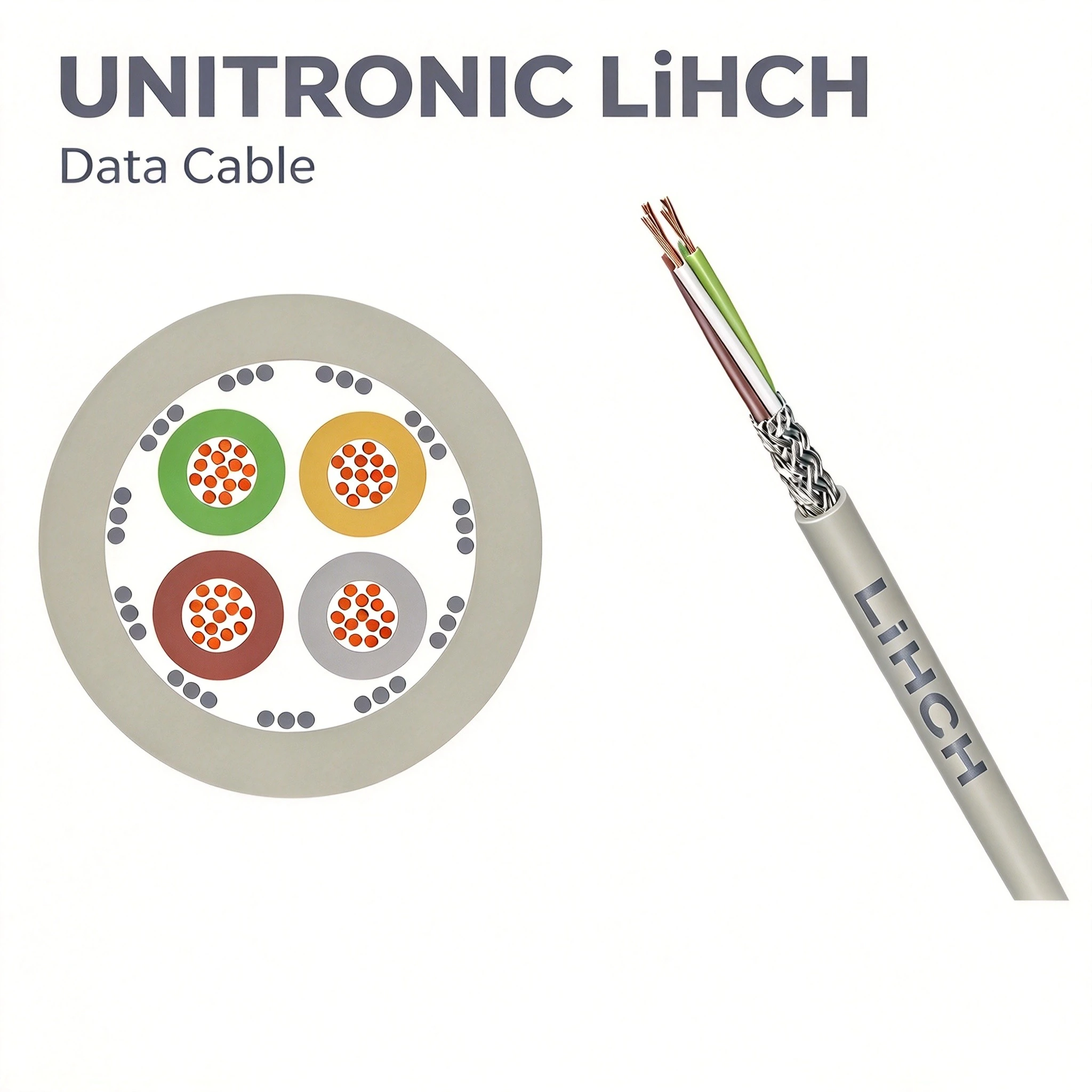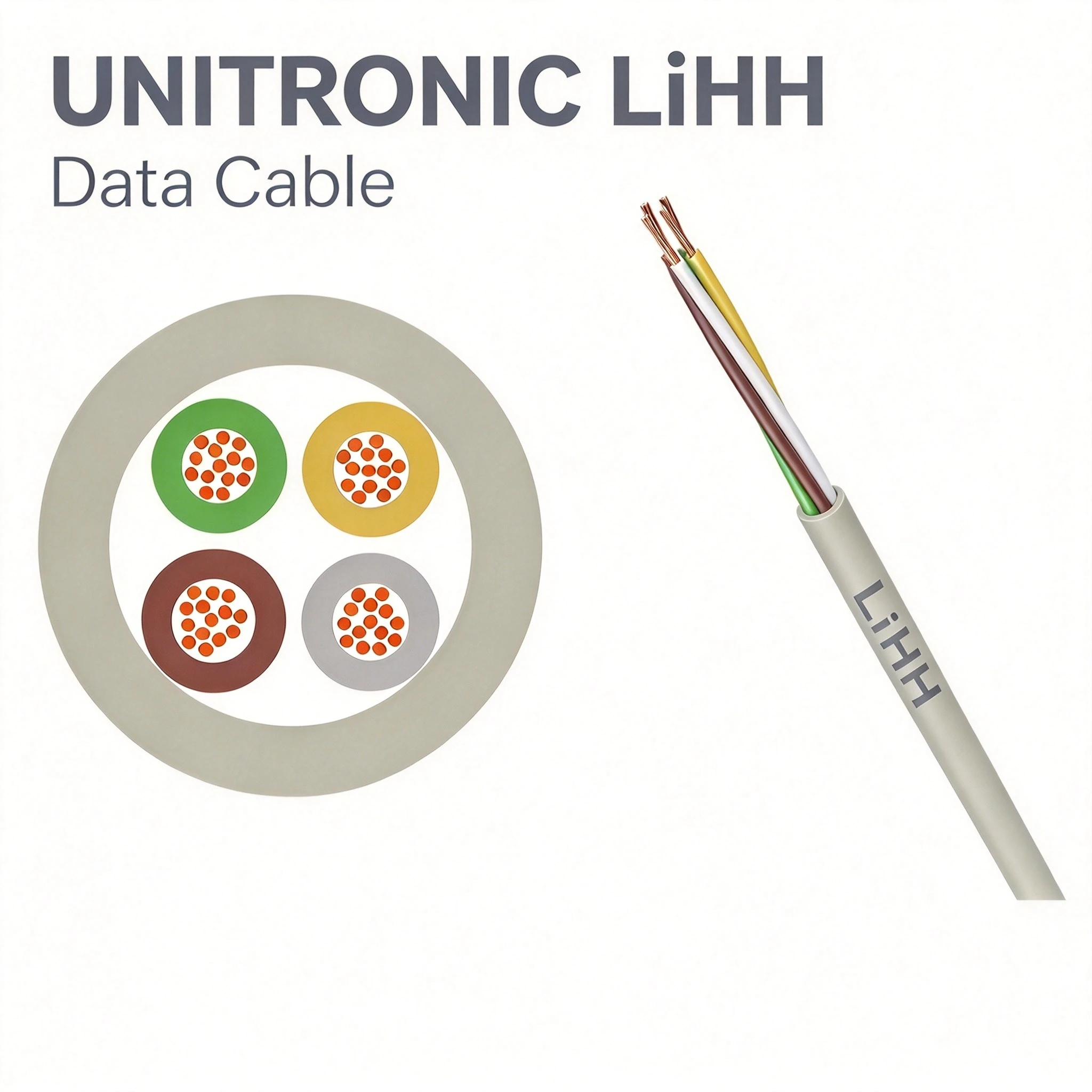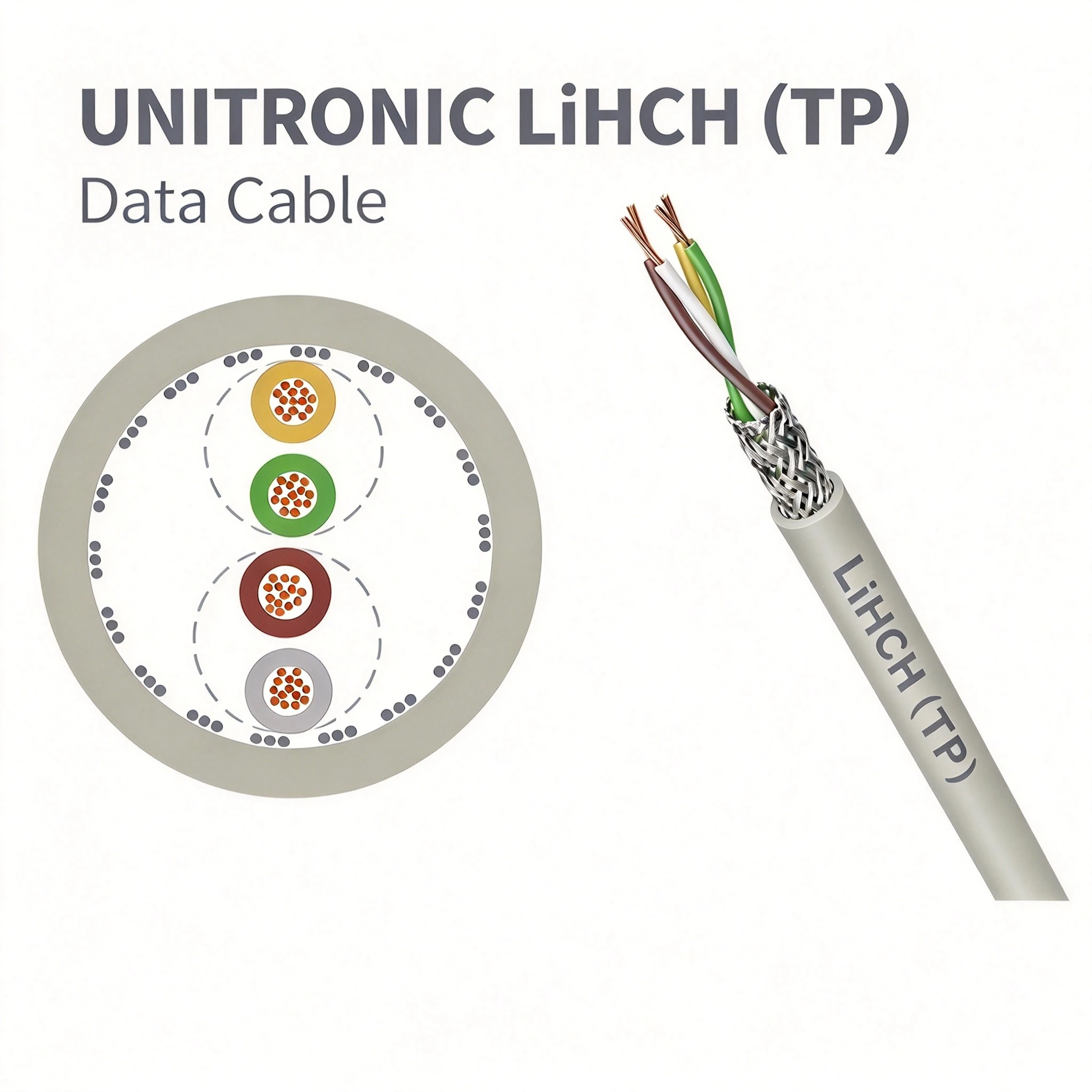
Xiamen Kabasi Electric Co., Ltd. is one of the most reliable manufacturers and suppliers of unitronic lihch (tp) data cable in China. If you're going to buy bulk durable cables made in China, welcome to get pricelist from our factory. All customized cables are with high quality and competitive price.
Lead Paragraph
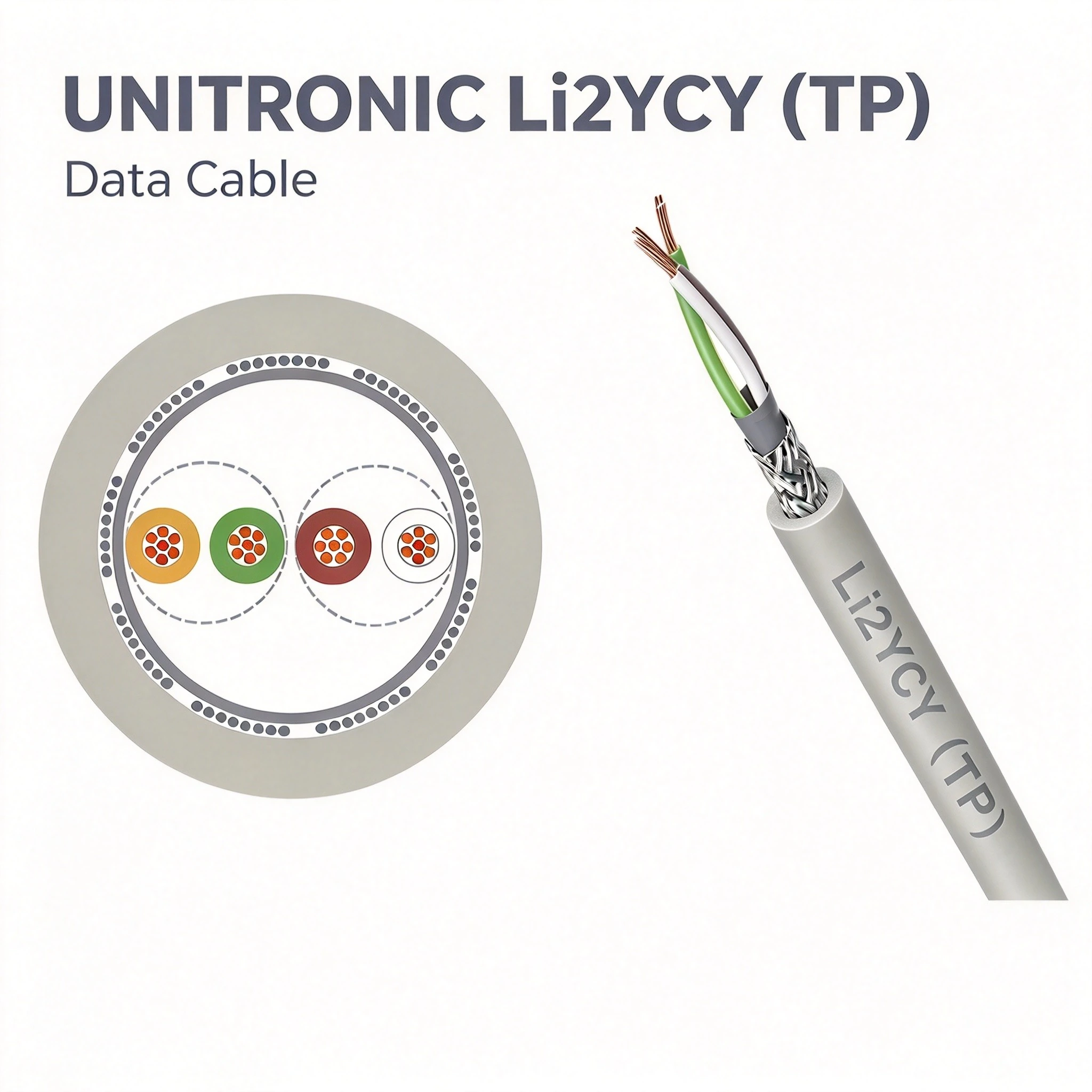
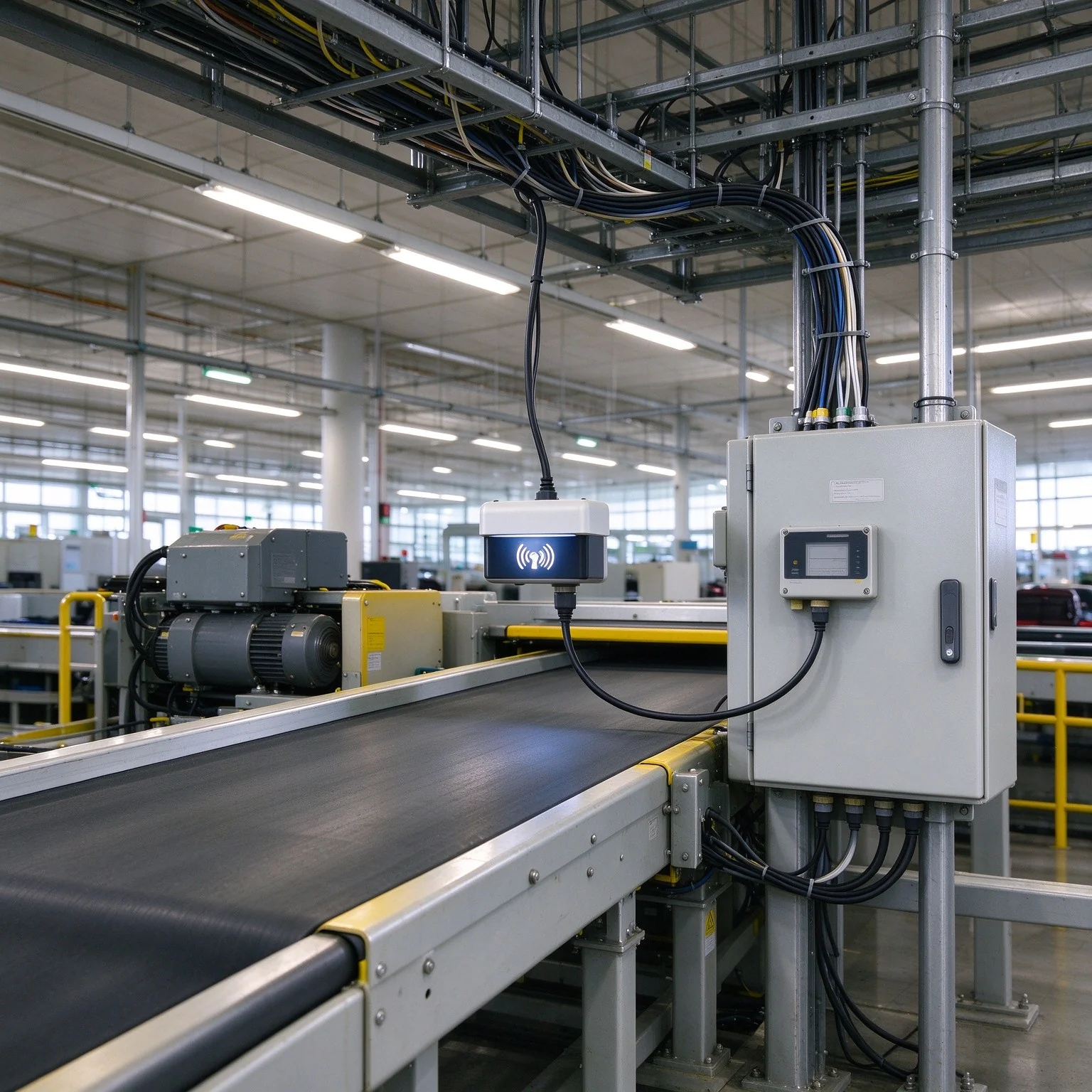
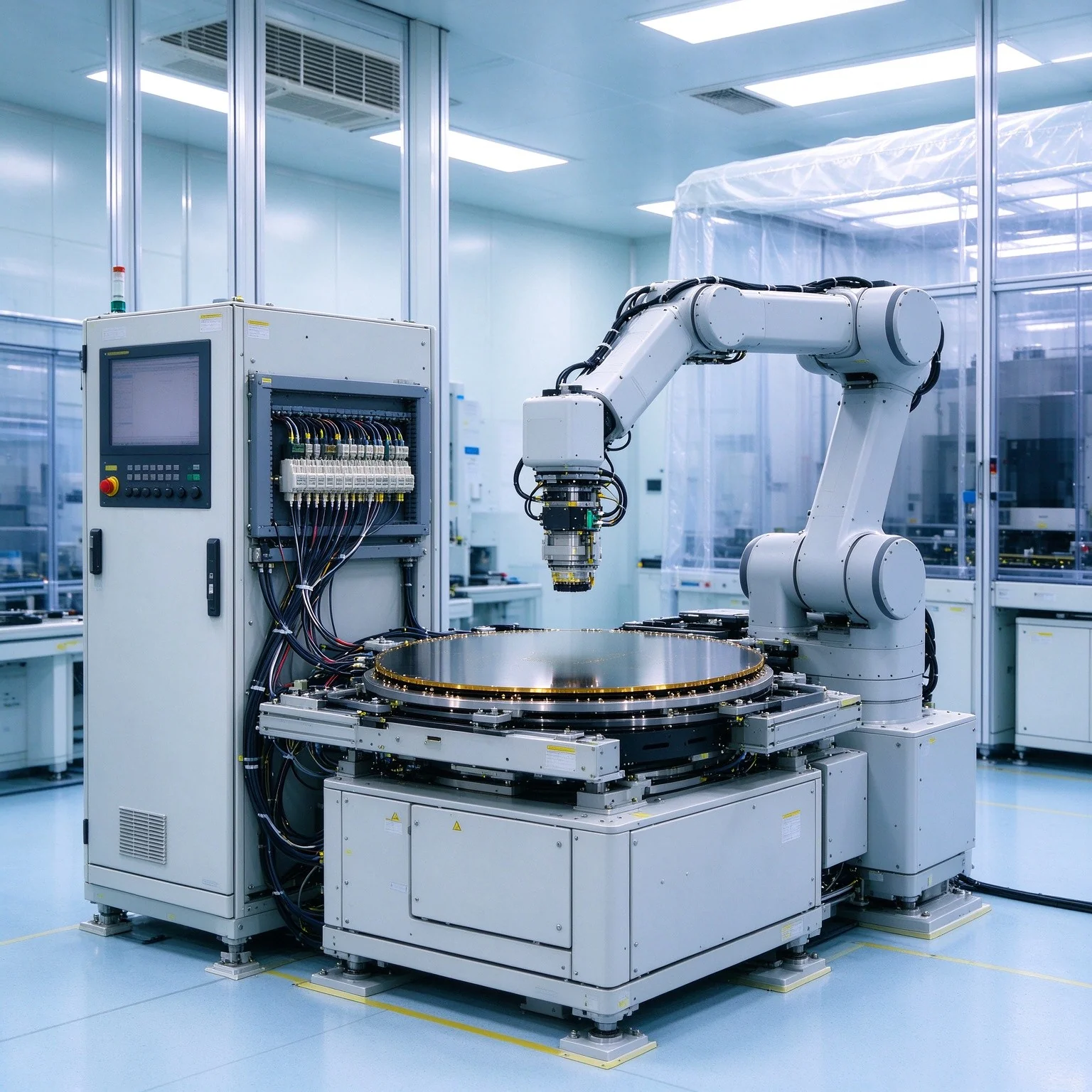
UNITRONIC LiHCH (TP) is a halogen-free twisted-pair data cable built to fight channel-to-channel crosstalk and external EMI at the same time. Conductors are wound into pairs at short, controlled lay lengths instead of being laid in parallel layers, so induced noise voltages cancel between half-twists and inter-channel capacitive coupling stays at 300 pF per 100 m at 1 kHz. An overall tinned copper braid takes care of radiated interference, while the LSZH polyolefin jacket meets IEC 60754-1/2 for acid-gas-free combustion and IEC 61034-2 for low smoke. Those four are the reason it goes into public buildings, transport systems and factory floors, wherever a screened, halogen-free cable of small cross-section is needed.
Select Your Variant
Screened Data Cable Comparison: LiHCH (TP) (Twisted Pair) vs. LiHCH (Concentric Layered)
|
System Specification Criterion |
UNITRONIC LiHCH (TP) (Twisted Pair Screened) |
UNITRONIC LiHCH (Concentric Layered Screened) |
Target Application Recommendation |
|
Conductor Twisting Configuration |
Cores twisted into distinct pairs (TP); pairs laid up together |
Cores stranded in concentric circular layers without pairing |
Where circuits must stay decoupled from each other, take the TP version; where the cable is only carrying discrete signals and the run has tight 90° bends, the layered version bends harder. |
|
Crosstalk Attenuation |
Coupling capacitance (K) approx. 300 pF/100 m |
Moderate capacitive coupling between adjacent parallel cores |
LiHCH (TP) is the version to take when transmitting pulses and microvolt analog signals within the same multi-conductor jacket. |
|
Minimum Bending Radius (Flexing) |
15 × cable outer diameter (due to paired spiral lay) |
10 × cable outer diameter (more compact flexibility) |
Where raceways feature exceptionally tight 90° bends and signals are non-differential, standard LiHCH offers a smaller footprint. |
|
Pair Identification |
DIN 47100 pair color code (e.g. white/brown, green/yellow pairs) |
DIN 47100 sequential core color code |
LiHCH (TP) simplifies differential +/- polarity wiring by presenting clearly identifiable matched wire pairs at terminal blocks. |
Why Choose UNITRONIC LiHCH (TP) Series
|
Advantage |
What it means on site |
|
True Twisted-Pair (TP) Construction Cancels Channel-to-Channel Crosstalk |
Decouples circuits with a coupling capacitance of only about 300 pF/100 m, which is what keeps one channel's switching out of the next channel's signal. |
|
Dense Tinned Copper Braid Enforces Total External EMI Rejection |
With transfer impedance ≤ 250 Ω/km at 30 MHz, the overall shield repels motor drive noise, radio frequency arcing, and heavy conveyor electrical hash. |
|
Certified Low Smoke Zero Halogen (LSZH) Chemistry Protects Public Life |
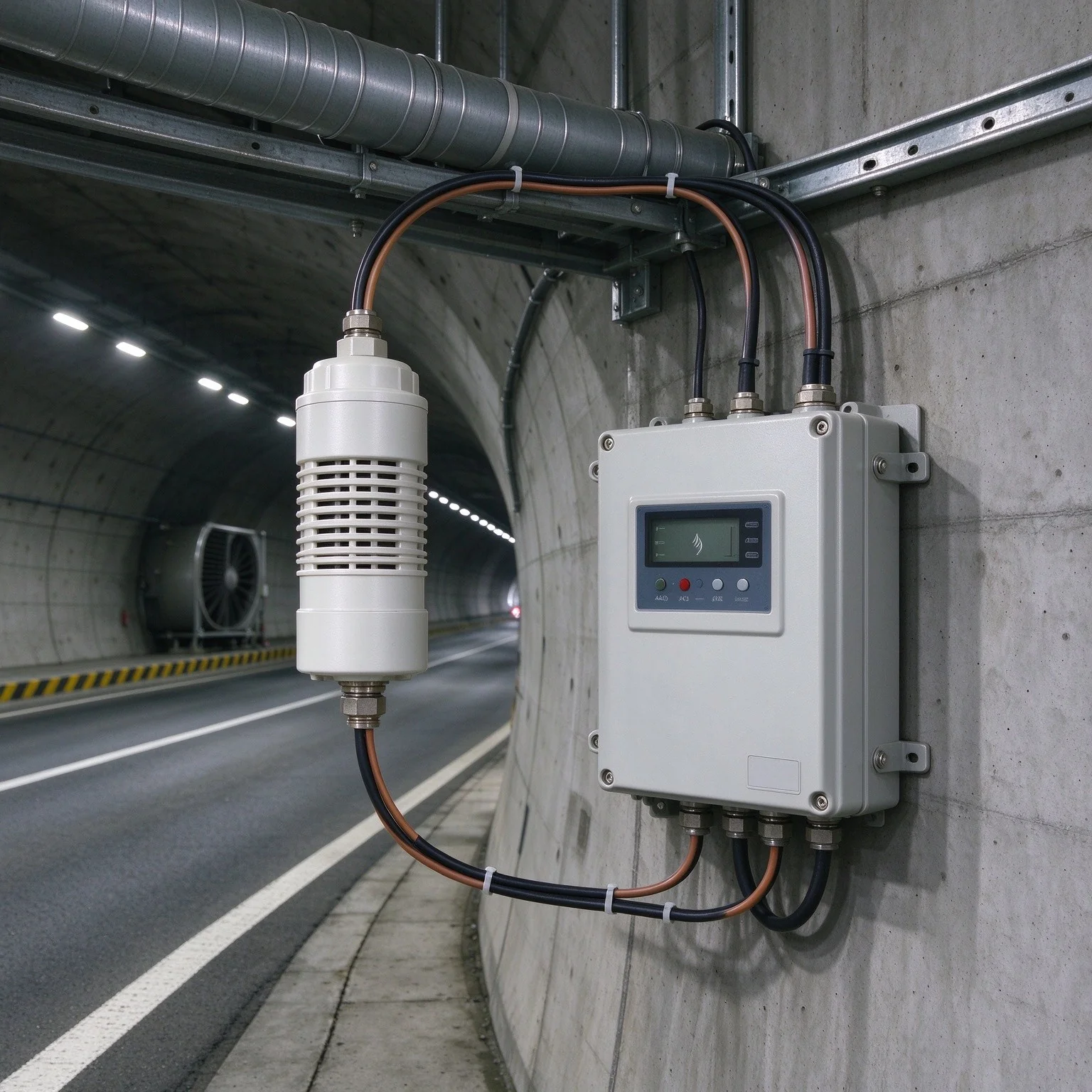
Releases zero corrosive halogen acid gases (IEC 60754-1/2) and preserves optical visibility (IEC 61034-2), which is the property that matters where the cable runs through a public building, a station or a tunnel. |
|
Comprehensive 27-Item Directory Covering 0.14 mm² to 1.0 mm² |
Spans from miniature 26 AWG sensor pairs up to robust 17 AWG long-distance telemetry runs, allowing unified procurement under a single engineering specification. |
Twisted Pair (TP) Circuit Decoupling Mechanics: Near-End Crosstalk (NEXT) Cancellation & Differential Telemetry
In high-density industrial control and railway signaling systems, multi-conductor cables carry asynchronous digital pulses alongside analog sensor signals. Without pair twisting, strong capacitive and inductive coupling leaches signal energy across channels. UNITRONIC LiHCH (TP) defeats cross-channel degradation through deliberate geometric symmetry:
|
Physical Decoupling Dimension |
Internal Twisted Pair (TP) Architecture |
Differential Signal Interaction |
Measurable Engineering Advantage |
|
Magnetic Field Loop Cancellation |
Alternating twist loops invert polarity every few millimeters along the cable length |
Induced EMF in one half-twist is equal in magnitude and opposite in sign to the adjacent half-twist, canceling net inductive pickup |
Prevents heavy switching pulses on channel 1 from inducing phantom trigger pulses on channel 2. |
|
Capacitive Unbalance Balancing |
Equalized geometric distance between paired conductors and surrounding cores/shield |
Capacitive coupling K maintained at approx. 300 pF/100 m at 1 kHz audio frequency test |
Keeps inter-pair capacitive coupling low, preventing high-frequency digital clock harmonics from distorting low-level analog readings. |
|
Common-Mode Rejection Ratio (CMRR) |
Tight, uniform twist lay length matches characteristic impedance throughout cable run |
External radiated EMI impacts both conductors in the pair identically; differential receiver amplifiers reject common-mode noise |
Keeps a differential receiver's common-mode rejection working, which is what lets a pair carry a small signal down a long run. |
|
Overall Braid Complementarity |
Overall tinned copper wire braided screen wraps around all twisted pairs |
Braided screen blocks high-frequency external RF hash; internal TP cancels internal inter-channel crosstalk |
Provides comprehensive dual-tier electromagnetic defense: external radiation immunity + internal cross-talk cancellation. |
By specifying UNITRONIC LiHCH (TP), automation systems engineers eliminate phantom sensor trips and serial bus CRC transmission retry delays caused by channel-to-channel crosstalk.
Frequently Asked Questions
Q: What does "(TP)" signify in the cable part description?
A: "(TP)" stands for "Twisted Pair" (in German: Paarverseilung). Rather than stranding cores in parallel circular concentric layers, conductors are twisted together into distinct pairs with a short, controlled lay length. This geometric twisting provides near-total cancellation of magnetic and capacitive crosstalk between adjacent signal pairs.
Q: Can UNITRONIC LiHCH (TP) be used for RS485 and Modbus RTU serial networks?
A: The cable's job is to keep signal circuits apart inside one jacket, which is what a balanced pair does; the catalogue specifies it for data processing, measurement and control engineering. Which bus runs on it is your system decision - we quote the pair count and cross-section.
Q: Why is the minimum bending radius of LiHCH (TP) larger than standard LiHCH?
A: Twisted-pair cables require a slightly larger bending radius (15 × outer diameter for occasional flexing, compared to 10 × OD for layered LiHCH) to preserve the mechanical geometry and lay pitch of the internal wire pairs. Excessive bending can compress or distort pair twisting, compromising high-frequency crosstalk attenuation.
Q: What is the benefit of the DIN 47100 pair color code?
A: The DIN 47100 pair code organizes conductors into intuitive color-matched pairs (e.g. Pair 1 = White / Brown, Pair 2 = Green / Yellow, Pair 3 = Grey / Pink). This eliminates guessing during termination and prevents errors where technicians might mistakenly pair conductors from two separate communication circuits.
Q: What is the capacitive coupling value of UNITRONIC LiHCH (TP)?
A: The mutual capacitive coupling (K) at 1 kHz audio frequency is approximately 300 pF per 100 meters. This exceptionally low value confirms high electrical decoupling between adjacent circuits, preventing audio bleed-through, signal ghosting, and digital frame corruption across long cable distances.
Hot Tags: unitronic lihch (tp) data cable, China unitronic lihch (tp) data cable suppliers
Electrical, Mechanical & Twisted-Pair Parameters
|
Technical Parameter |
Standard Reference & Certified Value |
|
Conductor Stranding |
Class 5 fine bare copper strands; multiple-wire flexible structure compliant with VDE 0812 |
|
Core Insulation |
Special halogen-free polyolefin compound (reduced mutual capacitance and low dielectric loss) |
|
Twisted-Pair Geometry |
Cores twisted into pairs (TP) with short lay lengths; pairs cabled together in concentric layers |
|
Screening Structure |
Overall tinned copper wire braided screen (transfer impedance ≤ 250 Ω/km @ 30 MHz) |
|
Core Identification |
DIN 47100 pair color code without color repetition (DIN 47100, no repeated colours) |
|
Outer Sheath Material |
Special halogen-free flame-retardant compound (LSZH), pebble grey (similar to RAL 7032) |
|
Peak Operating Voltage |
250 V (for low-voltage serial bus, data, and instrumentation circuits; not for mains power) |
|
Dielectric Test Voltage |
1200 V AC (spark tested and core/core, core/screen proof tested) |
|
Mutual Capacitance (Core/Core) |
Approx. 80 nF/km (at 800 Hz) |
|
Mutual Capacitance (Core/Screen) |
Approx. 120 nF/km (at 800 Hz) |
|
Capacitive Coupling (K) |
Approx. 300 pF / 100 m (at 1 kHz, ensuring high inter-channel circuit decoupling) |
|
Inductance |
Approx. 0.65 mH/km |
|
Minimum Bending Radius |
Occasional flexing: 15 × outer diameter | Fixed installation: 6 × outer diameter |
|
Temperature Range (Flexing) |
−5 °C to +70 °C |
|
Temperature Range (Fixed) |
−30 °C to +80 °C |
|
Halogen Acid Gas Emission |
IEC 60754-1 - halogen-free |
|
Corrosiveness of Combustion Gases |
IEC 60754-2 - low corrosivity of combustion gases |
|
Smoke Density & Visibility |
IEC 61034-2 - low smoke density |
|
Toxicity of Combustion Fumes |
EN 50305 low toxicity index compliance |
|
Flame Retardance |
IEC 60332-1-2 single-cable vertical flame propagation test |
Metric to AWG Reference Notice
UNITRONIC LiHCH (TP) is manufactured to metric cross-sections with equivalent AWG ratings recognized for international engineering reference.
|
Metric Section (mm²) |
Equivalent North American AWG Designation |
|
0.14 |
26 |
|
0.25 |
24 |
|
0.5 |
20 |
|
0.75 |
18 |
|
1.0 |
17 |
UNITRONIC LiHCH (TP) — Part Number Directory
Halogen-free twisted-pair screened flexible data cable with DIN 47100 pair color code and overall copper braid. Selected catalogue listing from 0038302 to 0038804 with integrated AWG equivalents.
|
Part No. |
Pairs × mm² |
Equivalent AWG |
Outer Diameter (mm) |
Copper Index (kg/km) |
Total Weight (kg/km) |
|
0038302 |
2 x 2 x 0.14 |
26 AWG |
5.5 |
18.5 |
39 |
|
0038304 |
4 x 2 x 0.14 |
26 AWG |
6.4 |
26.6 |
54 |
|
0038308 |
8 x 2 x 0.14 |
26 AWG |
8.4 |
53.7 |
97 |
|
0038312 |
12 x 2 x 0.14 |
26 AWG |
9.1 |
66.0 |
142 |
|
0038325 |
25 x 2 x 0.14 |
26 AWG |
12.7 |
113.0 |
238 |
|
0038402 |
2 x 2 x 0.25 |
24 AWG |
6.5 |
28.0 |
54 |
|
0038404 |
4 x 2 x 0.25 |
24 AWG |
7.8 |
44.9 |
81 |
|
0038406 |
6 x 2 x 0.25 |
24 AWG |
8.7 |
69.5 |
115 |
|
0038408 |
8 x 2 x 0.25 |
24 AWG |
10.5 |
76.9 |
130 |
|
0038416 |
16 x 2 x 0.25 |
24 AWG |
12.7 |
146.5 |
238 |
|
Part No. |
Pairs × mm² |
Equivalent AWG |
Outer Diameter (mm) |
Copper Index (kg/km) |
Total Weight (kg/km) |
|
0038602 |
2 x 2 x 0.5 |
20 AWG |
8.1 |
48.1 |
93 |
|
0038604 |
4 x 2 x 0.5 |
20 AWG |
9.6 |
82.0 |
146 |
|
0038606 |
6 x 2 x 0.5 |
20 AWG |
11.3 |
110.0 |
198 |
|
0038608 |
8 x 2 x 0.5 |
20 AWG |
13.3 |
139.0 |
259 |
|
0038616 |
16 x 2 x 0.5 |
20 AWG |
16.7 |
240.0 |
459 |
|
0038702 |
2 x 2 x 0.75 |
18 AWG |
8.7 |
58.0 |
106 |
|
0038704 |
4 x 2 x 0.75 |
18 AWG |
10.9 |
108.0 |
179 |
|
0038708 |
8 x 2 x 0.75 |
18 AWG |
14.9 |
180.0 |
305 |
|
0038802 |
2 x 2 x 1.0 |
17 AWG |
9.2 |
84.0 |
142 |
|
0038804 |
4 x 2 x 1.0 |
17 AWG |
11.5 |
121.0 |
212 |