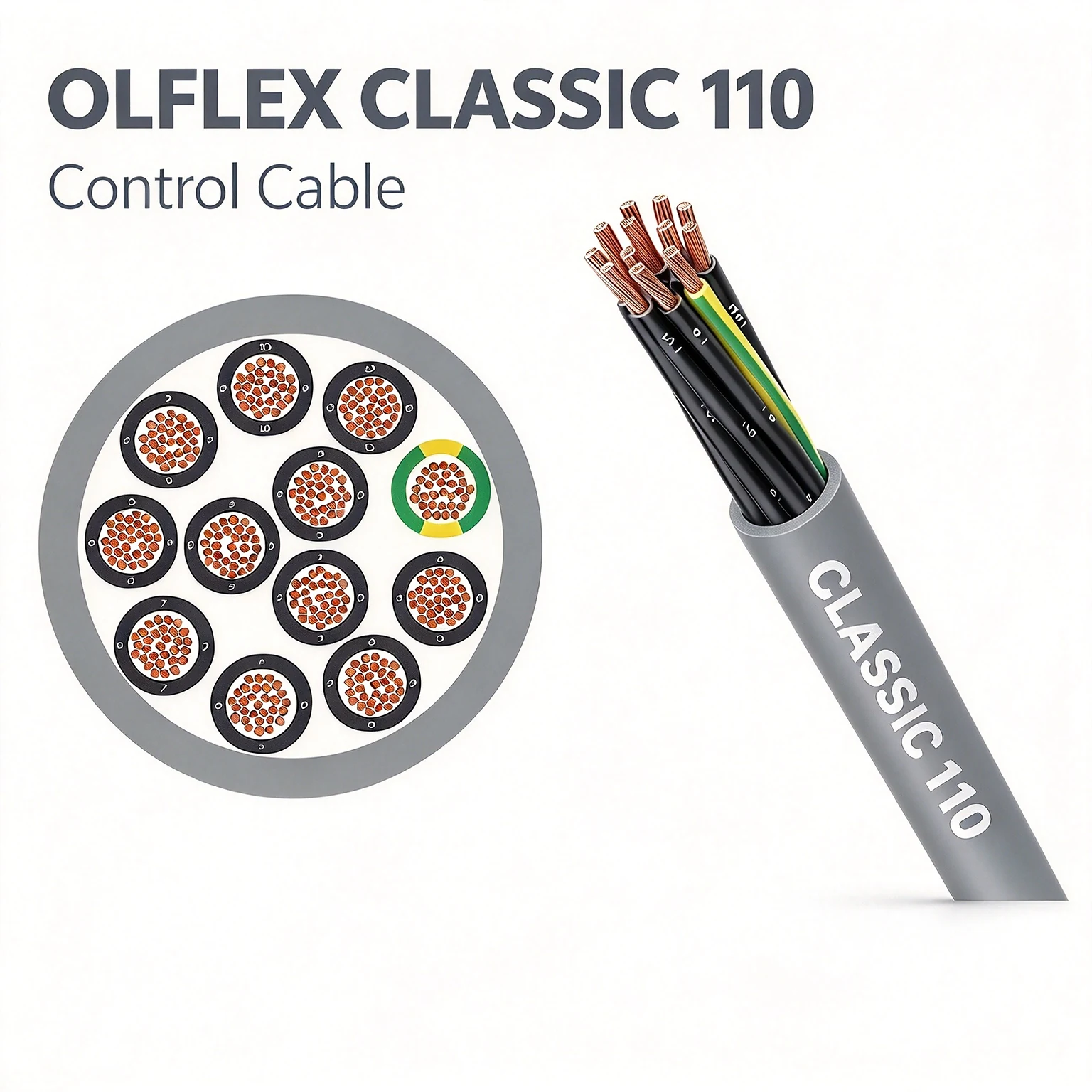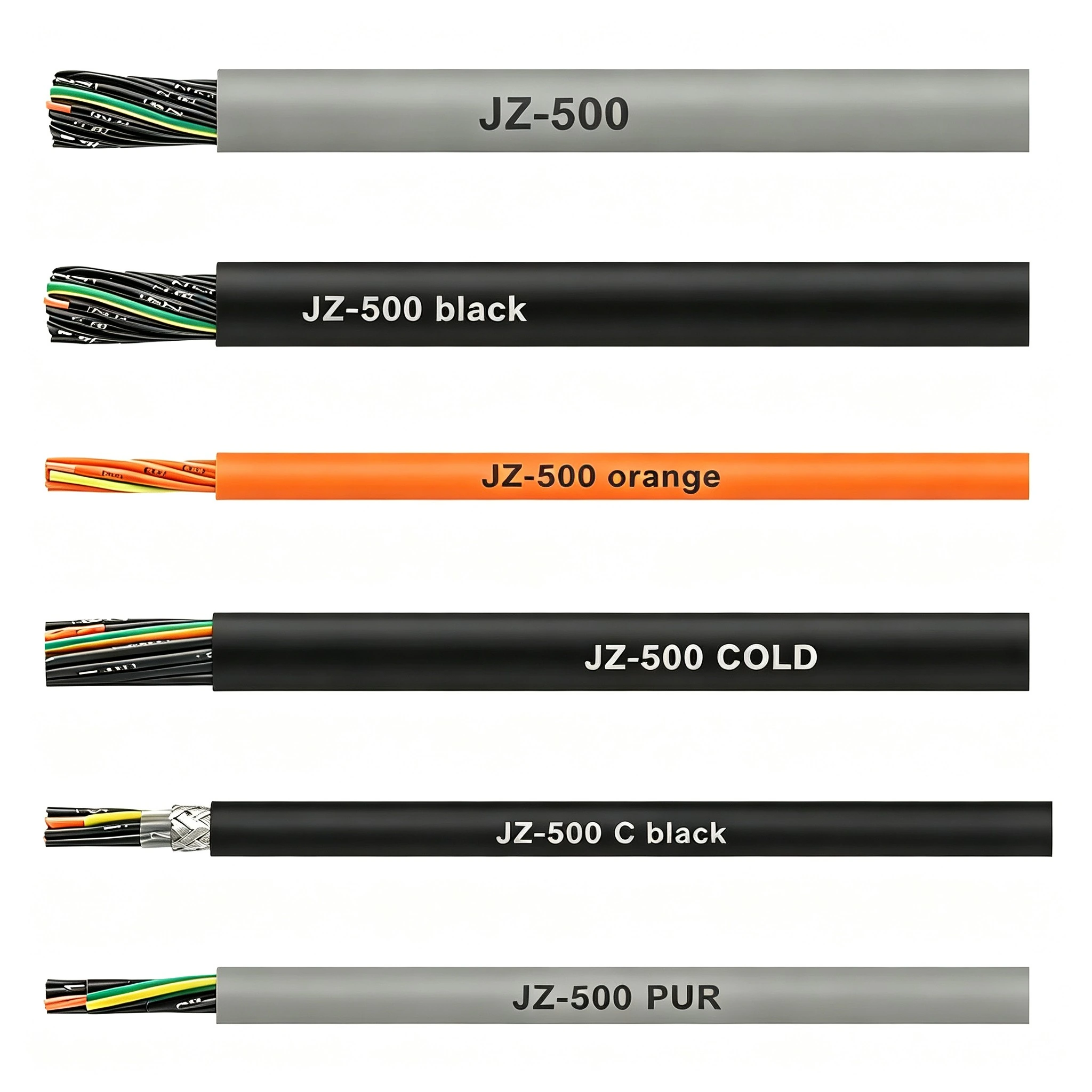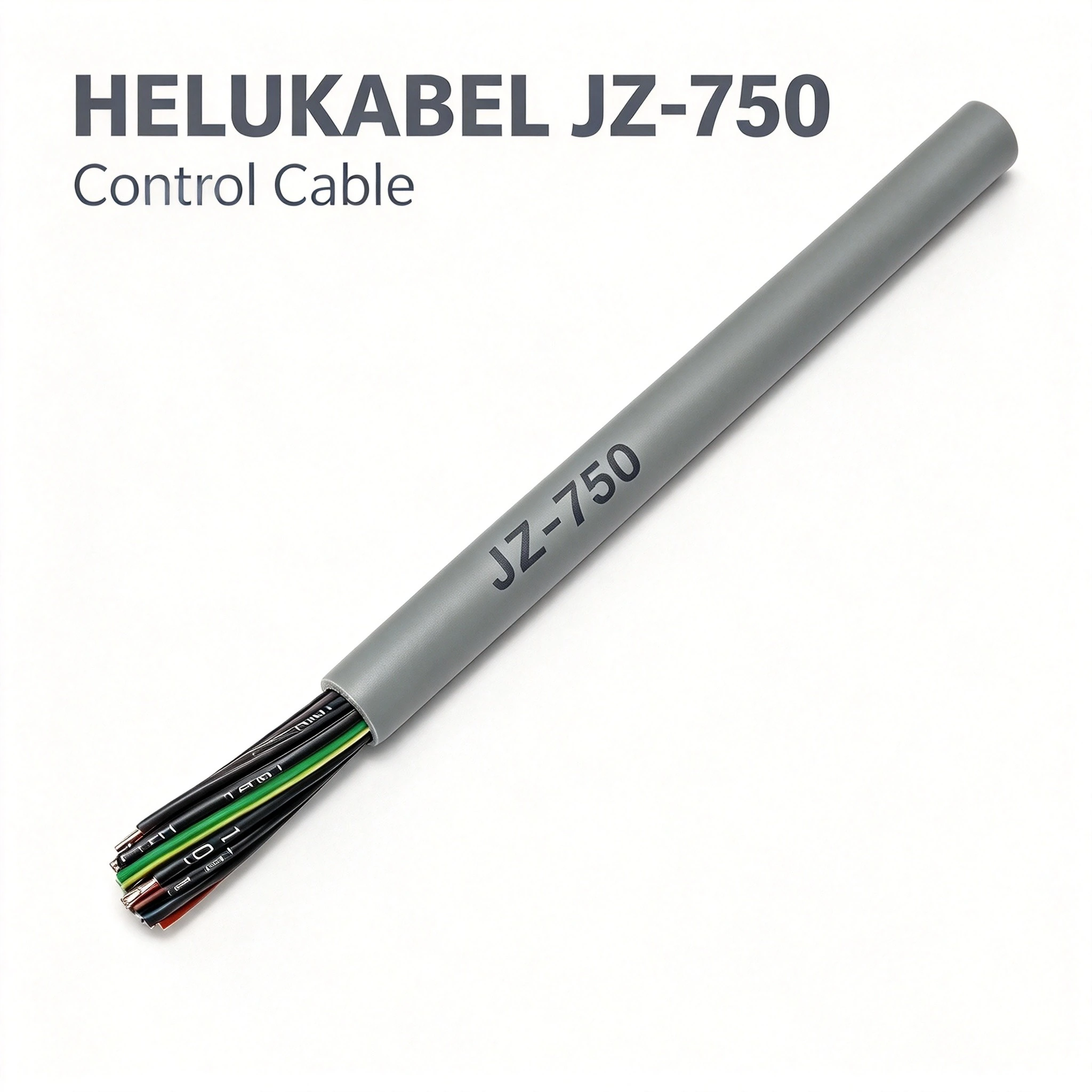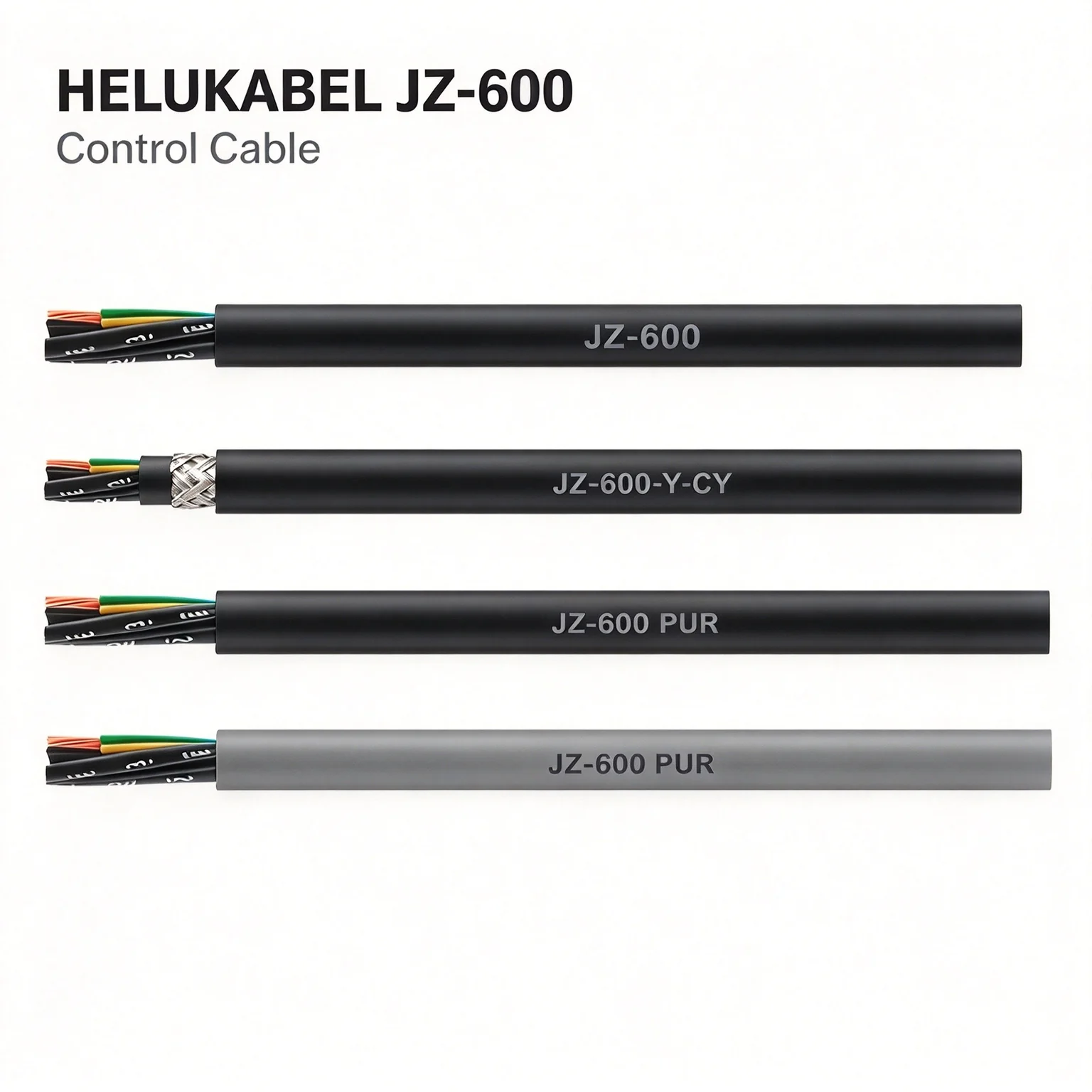
Xiamen Kabasi Electric Co., Ltd. is one of the most reliable manufacturers and suppliers of helukabel jz-600 control cable in China. If you're going to buy bulk durable cables made in China, welcome to get pricelist from our factory. All customized cables are with high quality and competitive price.
The 0.6/1 kV Control-Cable Line
JZ-600 is the 0.6/1 kV PVC control-cable line for fixed-installation control circuits. One conductor and construction family branches into six variants to absorb three separate requirements: screening, UL/CSA approval and a polyurethane sheath. Conductors are fine-strand bare copper to DIN VDE 0295 class 5; core insulation is special PVC TI2; the PVC types use a special PVC TM2 outer sheath and the PUR types a full polyurethane jacket. Cross-sections run from 0.5 mm² to 185 mm² with up to 100 cores, so one part-number set covers both multi-core cabinet signal wiring and the heavier power-and-control runs on the line. Three questions decide the variant: screening, UL/CSA approval, and whether coolant or mineral oil is present along the route.
Choosing Among the Six JZ-600 Variants
All six variants share the conductor, core insulation and stranding process. The differences sit in three places: whether a tinned copper braid screen is fitted, whether the outer sheath is PVC or polyurethane, and whether UL/CSA approval with the corresponding flame rating is carried. Placing them side by side is faster than working through the catalogue page by page.
Variant difference table
|
Variant |
Sheath / screen |
Approval coverage |
Bending radius (mobile / fixed) |
Mobile temp. / radiation |
|
JZ-600 |
PVC TM2, black RAL 9005, unscreened |
VDE / CE |
7.5 x / 4 x |
-15 to +80 C / 80 Mrad |
|
JZ-600-Y-CY |
PVC TM2 inner sheath + tinned copper braid (approx. 85%) |
VDE / CE |
10 x / 5 x |
-15 to +80 C / 80 Mrad |
|
JZ-600 UL/CSA |
PVC TM2, black RAL 9005 or grey RAL 7001, unscreened |
UL 758 Style 21179; UL VW-1 / CSA FT1 |
7.5 x / 4 x |
-5 to +80 C / 80 Mrad |
|
JZ-600-Y-CY UL/CSA |
PVC TM2 inner sheath + tinned copper braid (approx. 85%) |
UL 758 Style 21179; UL VW-1 / CSA FT1 |
10 x / 5 x |
-5 to +80 C / 80 Mrad |
|
JZ-600 PUR |
Full polyurethane TMPU, black RAL 9005 or grey RAL 7001, unscreened |
UL 758 Style 20234 |
7.5 x / 4 x |
-5 to +80 C / 100 Mrad |
|
JZ-600-YC-PUR |
Oil-resistant PVC TM5 inner sheath + tinned copper braid (approx. 85%) |
UL 758 Style 20234 |
10 x / 5 x |
-5 to +80 C / 100 Mrad |
Narrow down by site condition
Matching site conditions directly to a variant removes comparison work that does not need to happen. The left column lists the triggers that usually appear on a drawing or at the installation point, the middle column names the variant, and the right column is what has to be checked again afterwards.
|
Drawing / site condition |
Variant |
What to re-check |
|
Ordinary fixed installation, no screening requirement |
JZ-600 |
The black sheath resists UV, so outdoor fixed installation works without extra shading; the catalogue states it is not suitable for direct burial or underwater use |
|
Near VFD outputs or servo circuits, interference suppression needed |
JZ-600-Y-CY |
The shield must be fully and completely contacted at both cable ends during installation, otherwise the coverage advantage is lost |
|
Machinery exported to North America, UL/CSA approval required |
JZ-600 UL/CSA |
Black and grey sheaths each carry their own article number, so the wire-colour convention must be fixed before ordering |
|
Exported to North America and screened as well |
JZ-600-Y-CY UL/CSA |
Tinned copper braid with a PVC TM2 inner sheath; check the 10 x / 5 x bending radius |
|
Coolant, emulsion or mineral oil splash at the installation point |
JZ-600 PUR |
The full polyurethane sheath resists mineral oil and coolant and wears better than the PVC types |
|
Coolant environment that also needs screening |
JZ-600-YC-PUR |
Oil-resistant PVC TM5 inner sheath, coupling resistance max. 250 ohm/km |
Typical Applications


Why Specify JZ-600
The six points below are the ones that come up most often during selection and that most affect rework cost. The right-hand column is what each one means at the installation point.
|
Engineering point |
Practical consequence |
|
One conductor specification covers six variants |
Screening, approval and sheath requirements converge inside a single numbering system, so re-checking after a variant change stays limited to terminal sizes and duct fill rather than re-learning a cable. |
|
1 kV class insulation wall |
Insulation and sheath are designed for 1 kV, so overall diameter and weight per unit length exceed the 300/500 V equivalents; duct fill and terminal bore have to be recalculated from the actual diameter. |
|
Approx. 85% screen coverage, coupling resistance max. 250 ohm/km |
The tinned copper braid gives a measurable screening figure, which makes interference suppression next to VFD outputs and servo circuits assessable before the cable is ordered. |
|
Two sheath colours on the UL/CSA types |
Black RAL 9005 and grey RAL 7001 each carry a separate article number, so a panel builder can follow a downstream customer wire-colour convention instead of compromising one colour across two projects. |
|
Up to 100 Mrad radiation resistance on the PUR types |
The polyurethane outer sheath tolerates mineral oil and coolant, so machining and rolling-mill areas need neither extra protective conduit nor a separate tray. |
|
Core numerals with underlining |
Each core can be checked individually during multi-core termination; the numerals do not run together and misread, which cuts rework from crossed connections. |
Frequently Asked Questions
Q: How do I decide whether screening is needed?
A: Start with whether the circuit shares a duct with VFD outputs, servo drives or pulse signals. If it does and the signal amplitude is low, take the -Y-CY type with the tinned copper braid; for ordinary relay circuits inside a cabinet the unscreened type is sufficient. Two costs of screening should be budgeted up front: the bending radius grows from 7.5 x / 4 x to 10 x / 5 x and the diameter is slightly larger at the same size; and the catalogue explicitly requires the shield to be fully and completely contacted at both cable ends, without which the coverage advantage is cancelled.
Q: Is the 1000 V on the UL/CSA types the same as the VDE 600/1000 V?
A: They are two different declarations that can be read side by side. The four UL/CSA and PUR types give two lines on the catalogue page: VDE U0/U 600/1000 V and UL/CSA 1000 V. UL/CSA 1000 V is the rating inside the North American system, and the construction behind it is the 1 kV insulation wall with UL 758 Style 21179 (PVC types) or Style 20234 (PUR types). An export project writing 1000 V and a domestic project writing 0.6/1 kV therefore describe the same cable, but the evidence sits in two different standards and the matching line has to be quoted for each submission.
Q: Do the JZ-600 and 300/500 V versions differ only in voltage class?
A: Not only in voltage. The 300/500 V version is built as a control cable to DIN VDE 0285-525-2-51 / DIN EN 50525-2-51, with low-voltage control-cable wall thicknesses for insulation and sheath. This family is built to DIN VDE 0262 (PVC types) or DIN VDE 0276 part 627 (1 kV types), with insulation wall thickness designed for 1 kV. The direct consequence is a larger diameter and weight per metre: duct fill, terminal bore and drum length all have to be recalculated for the same nominal size. Conversely, if the circuit rating genuinely stays at or below 300/500 V, the 300/500 V version is thinner and uses less material.
Q: Why do the PUR types start at -5 C for mobile installation while the PVC types reach -15 C?
A: These are two separate ranges in the catalogue rather than a typographical error: JZ-600 and JZ-600-Y-CY are rated for mobile installation from -15 C to +80 C, while the four UL/CSA and PUR types are rated from -5 C to +80 C, with fixed installation uniformly -40 C to +80 C. The low-temperature difference comes from the formulation priorities of the insulation and sheath compounds: this family puts its emphasis on oil, chemical and abrasion resistance in both the PVC and PUR types. Where a project needs repeated movement below -15 C, that point should be raised and verified on its own instead of assuming the lower value carries across the family.
Q: When one size shows two article numbers in the part-number tables, which one do I take?
A: Read the column header first. The JZ-600 and JZ-600-Y-CY tables split into G and x columns: G means the cable includes a green-yellow earth core, x means it does not (the OZ design). The four UL/CSA and PUR types split into black and grey columns covering the RAL 9005 and RAL 7001 sheath colours, and each colour carries its own number at the same size, so the wire-colour convention has to be settled before taking a number. Note that on the screened types the x column does not exist for every core count: across 0.5 to 2.5 mm2, JZ-600-Y-CY lists G article numbers only from 3 cores upwards.
Q: How are minimum order quantity and lead time confirmed?
A: The tables on this page list the common sizes and serve to show quickly whether a size sits inside the standard range. Actual minimum order quantity, drum length and lead time vary with size, sheath colour and variant and have to be confirmed against the specific article number. For the four types carrying UL/CSA approval it is worth confirming the accompanying documents at quotation stage as well, so that approval paperwork does not turn out to be incomplete after delivery.
Hot Tags: helukabel jz-600 control cable, China helukabel jz-600 control cable suppliers
Ratings Common to All Six JZ-600 Variants
|
Rated voltage |
Conductor |
Fixed-installation temperature |
Factory test voltage |
Cross-section / core range |
|
0.6/1 kV (UL 1000V) |
Class 5 bare copper |
−40 °C to +80 °C |
4000 V |
0.5 – 185 mm² (2–100 cores) |
Parameters Shared by the Family and Variant-Specific Values
Parameters common to all six variants
|
Item |
Specification |
|
Conductor |
Fine-strand bare copper to DIN VDE 0295 class 5, BS 6360 class 5 and IEC 60228 class 5 |
|
Core insulation |
Special PVC TI2 to DIN VDE 0207-363-3 / DIN EN 50363-3 |
|
Stranding |
Cores stranded in layers at optimum pitch |
|
Earth core |
Green-yellow earth core in the outer layer (3 cores and above) |
|
Test voltage |
4000 V |
|
Breakdown voltage |
Minimum 8000 V |
|
Insulation resistance |
Minimum 20 Mohm x km |
|
Flame retardance |
DIN VDE 0482-332-1-2, DIN EN 60332-1-2, IEC 60332-1 (equivalent to DIN VDE 0472 part 804, test method B) |
|
Material statement |
Cadmium-free and silicone-free; free from materials that impair paint wetting |
Parameters that differ by variant
|
Item |
Difference |
|
Cable standard |
JZ-600 and JZ-600-Y-CY to DIN VDE 0262; the four UL/CSA and PUR types to DIN VDE 0276 part 627 |
|
Voltage marking |
JZ-600 and JZ-600-Y-CY carry U0/U 0.6/1 kV; the UL/CSA and PUR types carry both VDE 600/1000 V and UL/CSA 1000 V |
|
Screen construction |
Unscreened, or tinned copper braid at approx. 85% coverage with coupling resistance max. 250 ohm/km |
|
Inner sheath |
None / PVC TM2 (the two -Y-CY types) / oil-resistant PVC TM5 (-YC-PUR) |
|
Outer sheath material |
Special PVC TM2 (four PVC types) / full polyurethane TMPU (two PUR types) |
|
UV resistance |
JZ-600 and JZ-600-Y-CY state UV resistance directly; the four UL/CSA and PUR types achieve it through the black sheath |
|
Oil resistance wording |
The four PVC types state highly oil-resistant and refer to the technical information tables; the two PUR types state resistance to mineral oil and coolant |
|
Radiation resistance |
Four PVC types up to 80 Mrad; two PUR types up to 100 Mrad |
|
Direct burial |
The JZ-600 page states not suitable as a direct-burial cable (suitable for direct burial above 18.0 mm outer diameter) or underwater cable; burying needs separate confirmation |
Approval Coverage, Variant by Variant
This section puts the approval and standard coverage of all six variants side by side, so an export machinery selection can be checked in one pass instead of page by page.
| Approval / standard | JZ-600 | JZ-600-Y-CY | JZ-600 UL/CSA | JZ-600-Y-CY UL/CSA | JZ-600 PUR | JZ-600-YC-PUR |
| Low Voltage Directive 2014/35/EU (CE) | √ | √ | √ | √ | √ | √ |
| DIN VDE 0295 class 5 / BS 6360 / IEC 60228 (conductor) | √ | √ | √ | √ | √ | √ |
| DIN VDE 0262 (PVC control cable) | √ | √ | - | - | - | - |
| DIN VDE 0276 part 627 (1 kV insulation) | - | - | √ | √ | √ | √ |
| DIN VDE 0285-525-2-51 / DIN EN 50525-2-51 | √ | √ | √ | √ | √ | √ |
| DIN VDE 0207-363-3 / DIN EN 50363-3 (TI2 core insulation) | √ | √ | √ | √ | √ | √ |
| DIN VDE 0293 (core identification) | √ | √ | √ | √ | √ | √ |
| DIN VDE 0207-363-4-1 / DIN EN 50363-4-1 (PVC outer sheath) | √ | √ | √ | √ | - | - |
| DIN VDE 0207-363-10-2 / DIN EN 50363-10-2 (PUR outer sheath) | - | - | - | - | √ | √ |
| DIN VDE 0482-332-1-2 / DIN EN 60332-1-2 / IEC 60332-1 (flame) | √ | √ | √ | √ | √ | √ |
| UL 758 Style 21179 | - | - | √ | √ | - | - |
| UL 758 Style 20234 | - | - | - | - | √ | √ |
| UL 1581 class 43 (core insulation and sheath) | - | - | √ | √ | √ | √ |
| UL-Style 10012 (core insulation) | - | - | - | - | √ | √ |
| UL VW-1 / CSA FT1 (flame) | - | - | √ | √ | - | - |
| UL 758 (outer sheath flame behaviour) | - | - | - | - | √ | √ |
The matrix is transcribed item by item from the characteristics, cable structure and technical data blocks of each variant page in the catalogue, and exists to show whether a given approval exists at the selection stage. Certificate numbers, validity dates and scopes of application follow the documents supplied with the actual delivery batch and can be requested separately.
Two kinds of statement have to be kept apart. DIN, EN, IEC and UL numbers are declarations of conformity with a standard. Wording such as highly oil-resistant, resistance to mineral oil and coolant, and UV resistant is the catalogue describing material tolerance, and for the four PVC types it refers oil and chemical resistance to the technical information tables. In a selection file these should not be written as the same thing.
Approval and Certification Coverage
DIN VDE 0295 cl. 5 / IEC 60228 | DIN VDE 0262 | DIN EN 50525-2-51 | DIN VDE 0293 | IEC 60332-1 | UL 758 (Style 21179 / 20234) | CSA FT1 | CE (2014/35/EU)
Three Numbering Schemes — Filter First
Part-number filtering — three numbering schemes appear on this page; pick the scheme first, then filter by core count and cross-section, or switch variant across the six sheath and approval types.
Common Size Part Numbers by Variant
Article-number logic and inline AWG scan
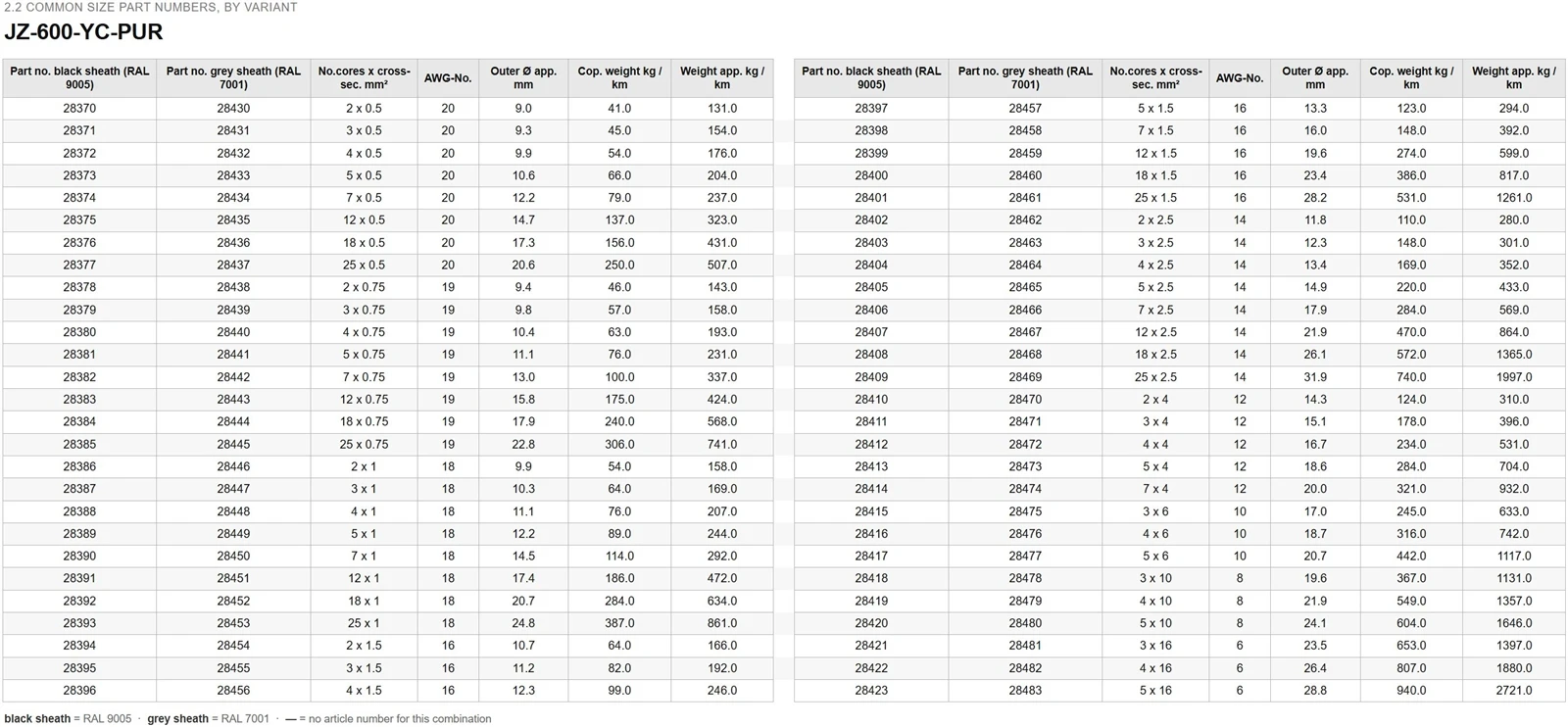
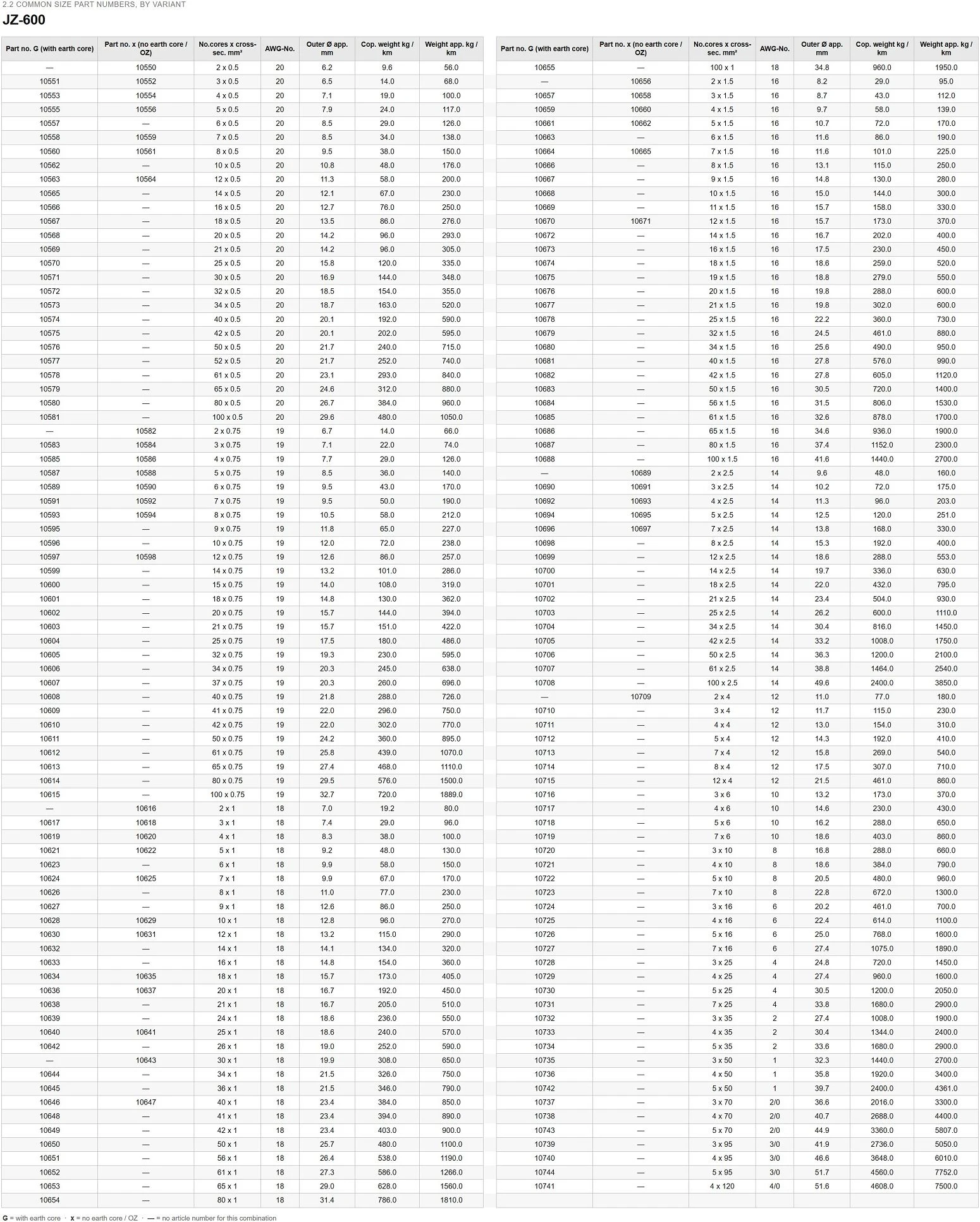
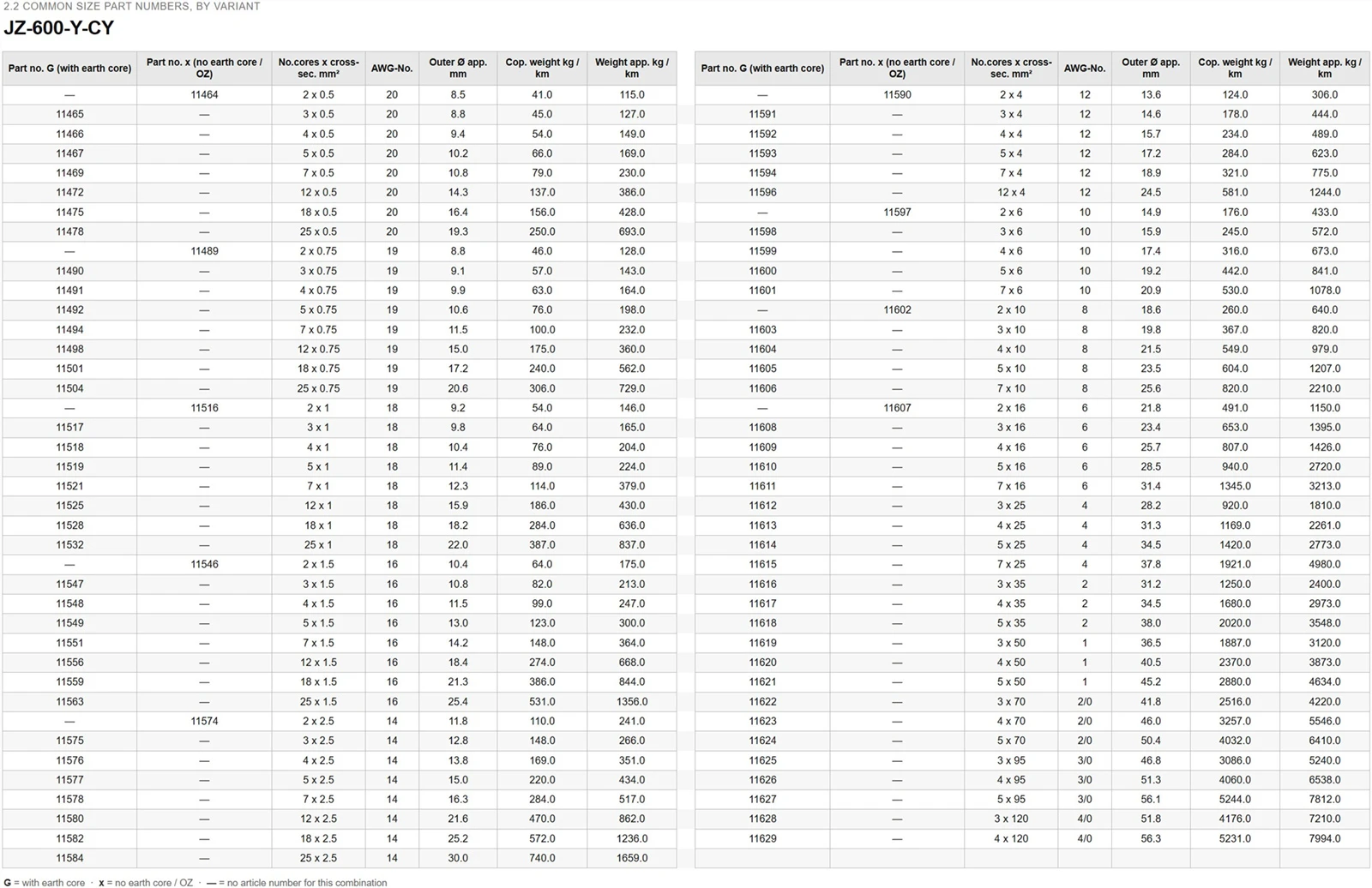
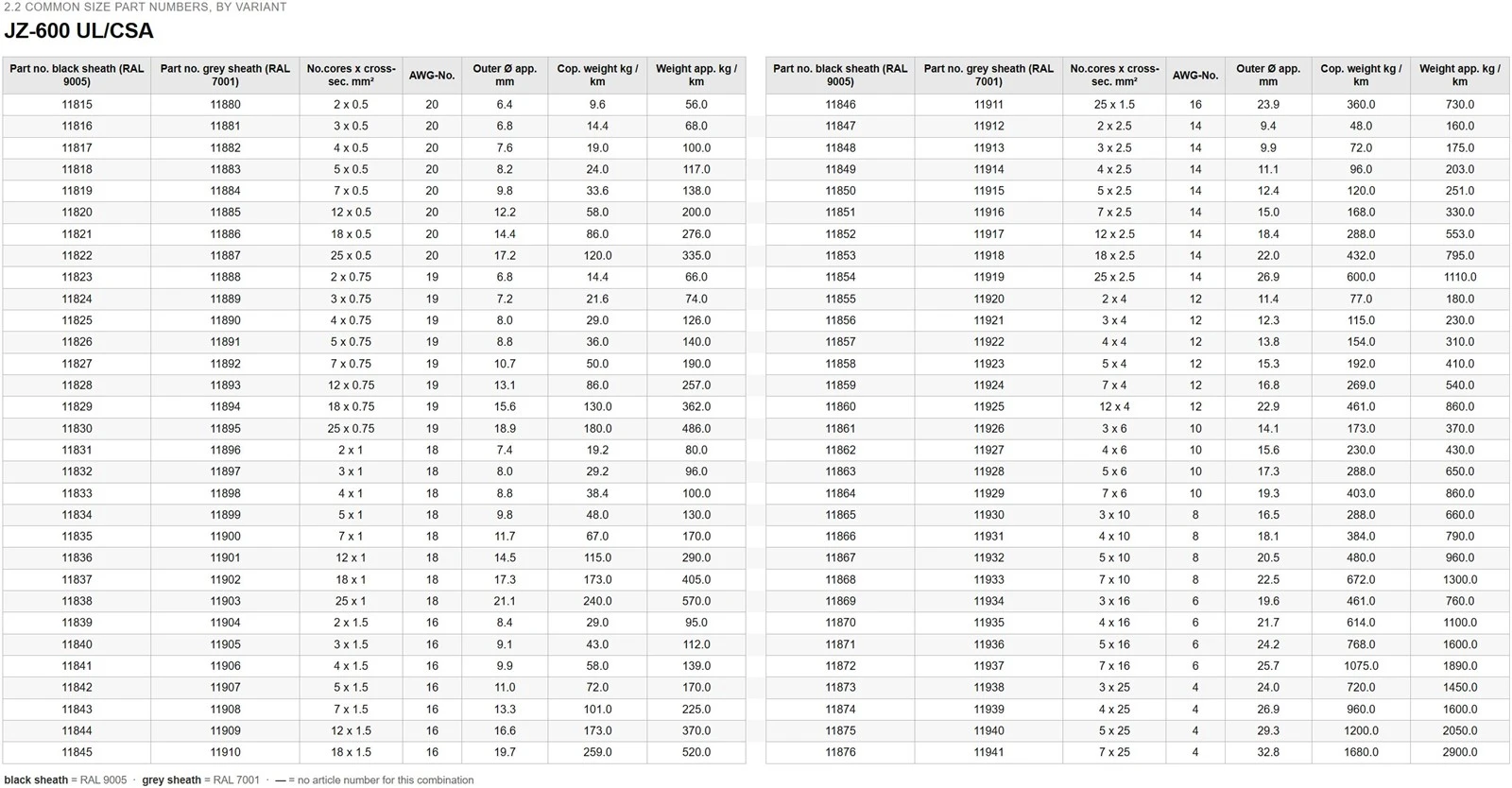
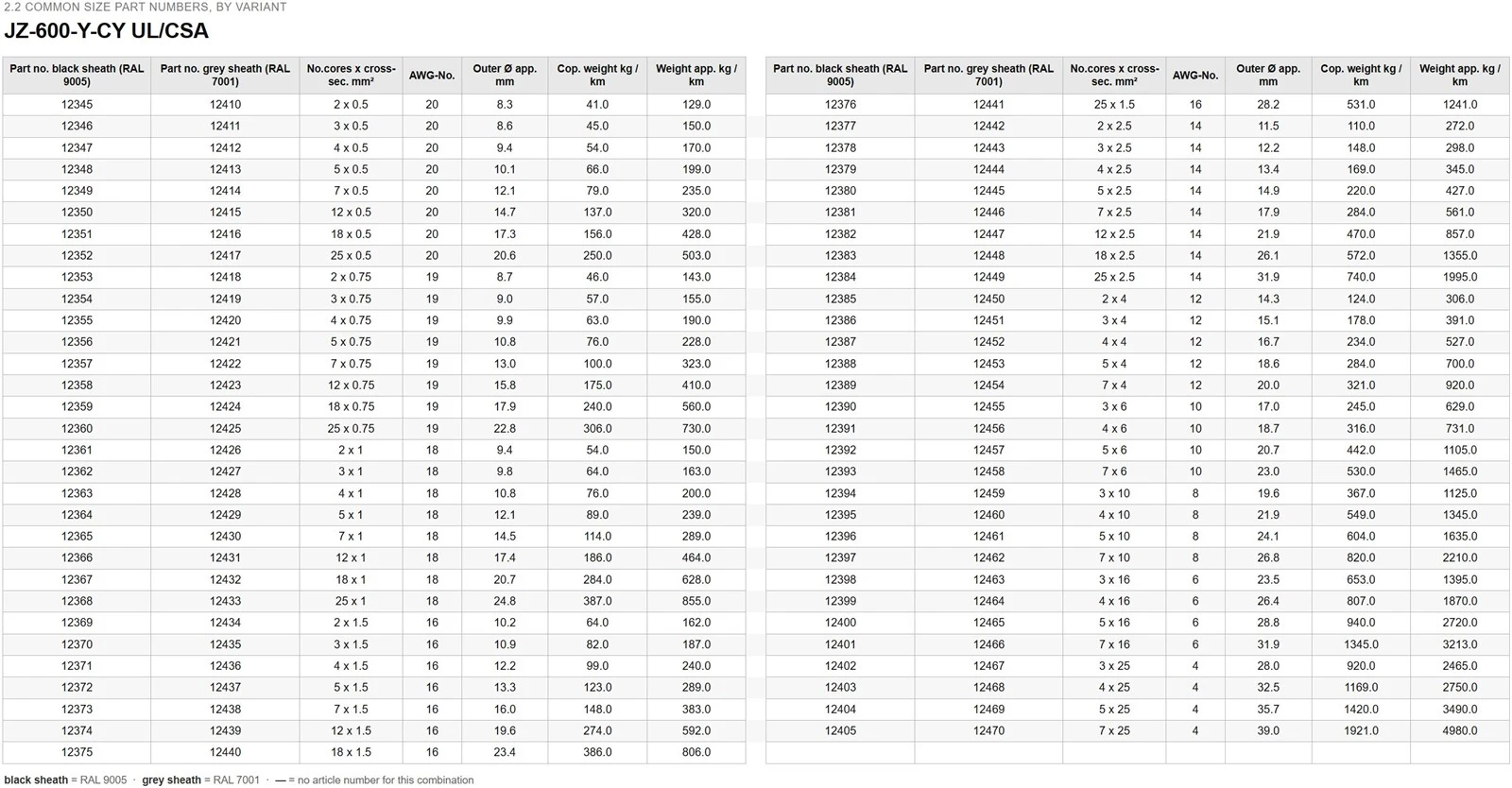
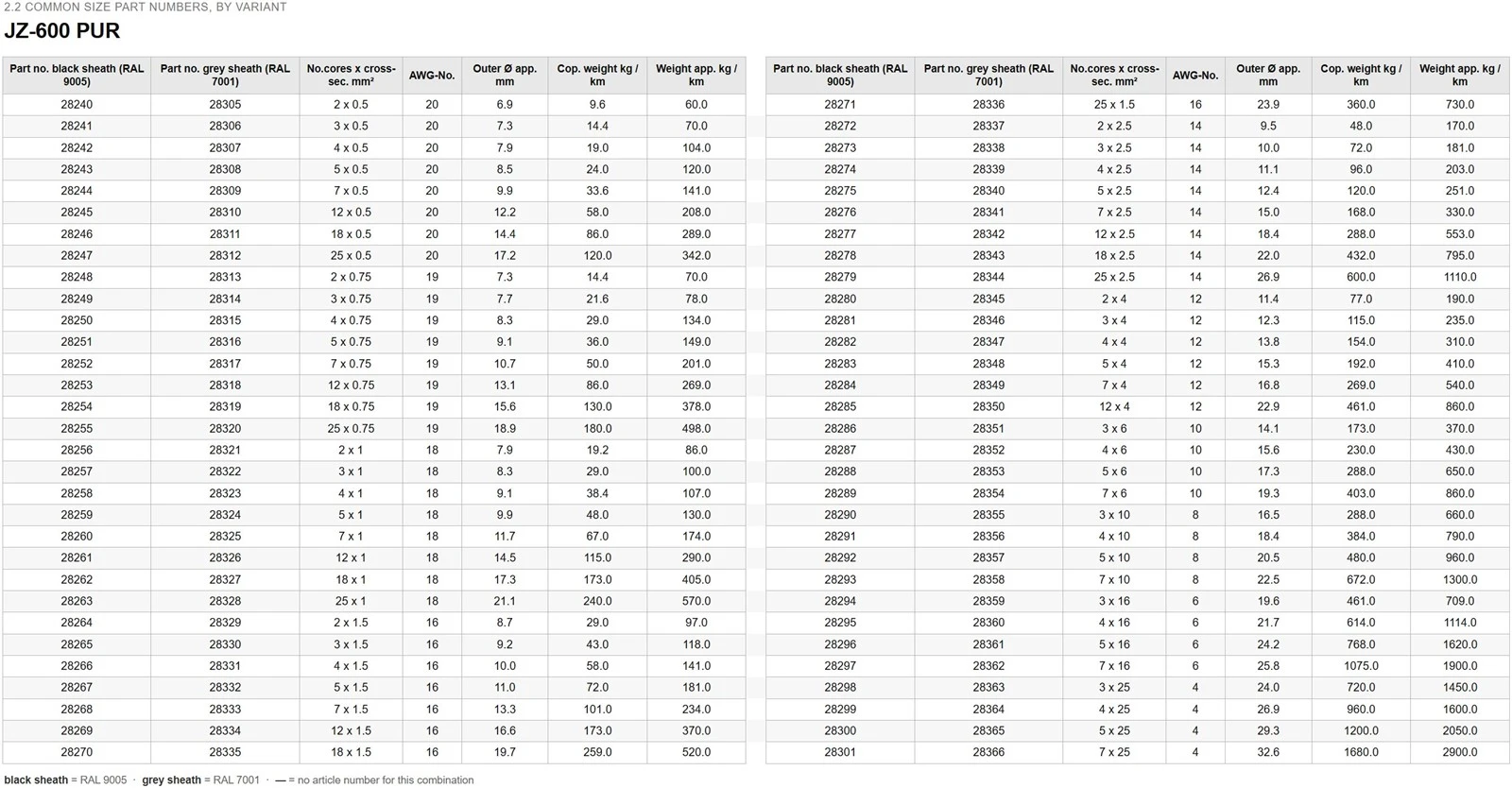
Three numbering schemes appear on this page, and which one applies has to be settled before a number is taken. JZ-600 and JZ-600-Y-CY occupy the ranges 10550-10746 and 11464-11629 respectively, each split into a G column (with green-yellow earth core) and an x column (without, the OZ design). The four UL/CSA and PUR types share one numbering scheme split by sheath colour into two consecutive ranges, black first and grey second, declared as a pair on the Master line of the catalogue page. Two colours at one size mean two distinct article numbers that are not interchangeable.
The AWG column is reproduced as printed, and the catalogue states that AWG sizes are approximate and that the actual cross-section is given in mm2. The five sizes used on this page scan as follows: 0.5 mm2 approx. AWG 20 | 0.75 mm2 approx. AWG 19 | 1 mm2 approx. AWG 18 | 1.5 mm2 approx. AWG 16 | 2.5 mm2 approx. AWG 14. Beyond this band the catalogue switches to fractional and kcmil designations for the heavier sizes, for example 70 mm2 as 2/0 and 150 mm2 as 300 kcmil.
Common size part numbers, by variant
The six tables below are listed one per variant. Size range, outer diameter, copper weight and weight per unit length are taken from the corresponding catalogue page; because the G/x columns, and the black/grey columns, share diameter, copper weight and total weight at a given size, those values are stated once.
JZ-600
JZ-600-Y-CY
JZ-600 UL/CSA
JZ-600-Y-CY UL/CSA
JZ-600 PUR
JZ-600-YC-PUR